


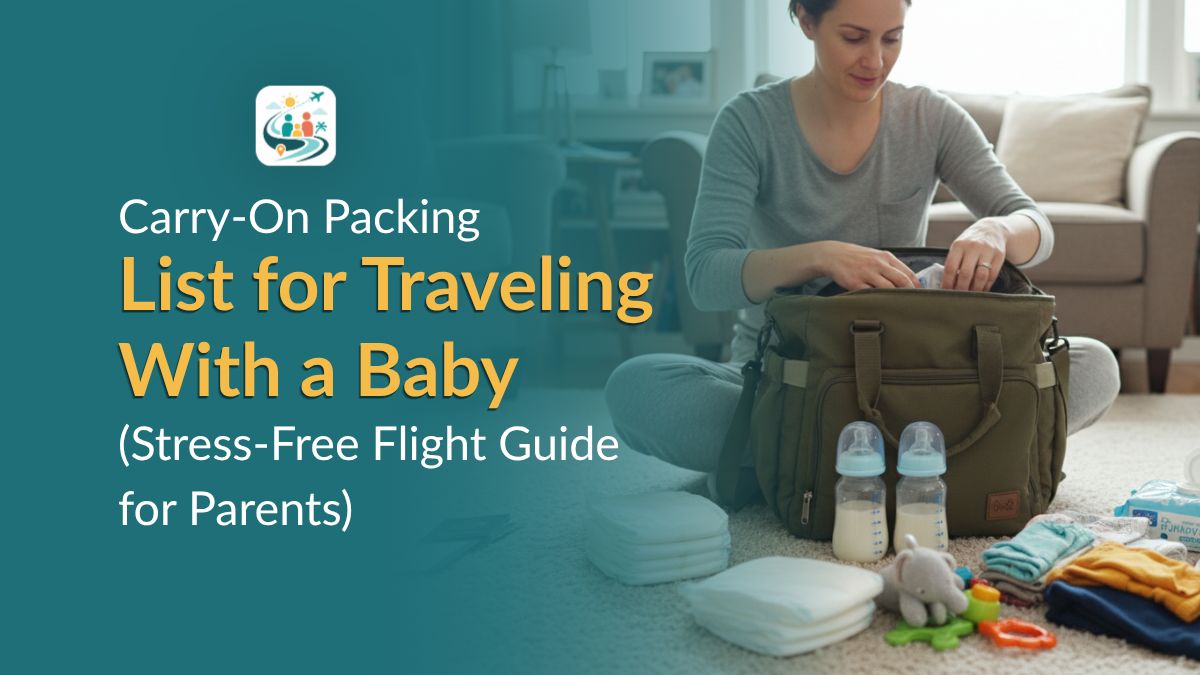
Packing a carry-on for a flight with a baby comes down to one question: what do you need if the trip takes twice as long as planned? Delays, missed connections, and blowouts are the actual risk, not the flight itself. For the whole trip — not just the carry-on — start with our baby and toddler travel packing list.
Key takeaways
- Pack for total travel time, not just flight duration.
- Baby formula, breast milk, and baby food are TSA-approved in carry-ons, above the standard 3.4 oz liquid limit.
- Keep essential items under your seat for quick access.
- Pack extra diapers, clothes, and feeding supplies beyond what the flight length suggests.
- A well-organized bag matters less than knowing what to do when something goes wrong mid-flight.
For everything else about the trip, see our complete guide to flying with a baby or toddler.
Quick carry-on checklist
Your baby carry-on should include:
- Diapers
- Baby wipes
- Portable changing pad
- Extra baby clothes
- Feeding supplies
- Comfort items
- Baby health items
- Parent backup essentials
Diapering essentials

- Diapers (1 per hour of travel, plus 2 extra)
- Baby wipes
- Travel-size diaper cream
- Disposable diaper bags
- Foldable changing pad
Feeding supplies
Pack extra feeding supplies for delays, not just the flight length.
Breastfeeding supplies: nursing cover, breast pads, burp cloths.
Bottle feeding supplies: bottles, formula or breast milk, bottle nipples, bottle cleaning brush, bibs.
Solid food supplies: baby food pouches, snacks, baby spoon, silicone bib.
Timing matters too — see feeding a baby during takeoff and landing.
TSA rules for baby items

Baby-related liquids are allowed in carry-on bags above the standard 3.4 oz limit.
What screening actually looks like
Airport security equipment varies enough that there’s no single answer here. Some airports run newer scanners that let you keep liquids and laptops packed, which speeds up the line. Others, or other lanes within the same airport, still run the older 3-1-1 setup and expect you to remove liquids into a checked-size bag, with enforcement depending partly on the individual agent’s judgment.
No scanner, old or new, can identify what’s inside a liquid just by looking at it. That’s why most airports keep a separate liquid scanner, about the size of a microwave, for items like baby food or medicine over 100 ml. Expect a short detour to that machine rather than a rejection. Budget a few extra minutes, since which lane you land in isn’t predictable ahead of time. If you’re babywearing, see wearing your baby through TSA for what to expect at the scanner.
Clothing and comfort items
Pack: 2 extra outfits, socks, a light jacket, and a swaddle or sleep sack.
Comfort items: pacifier, small toy, baby blanket.
Health and hygiene essentials
Include: baby medicine, thermometer, nasal spray, hand sanitizer, baby lotion.
Entertainment
Soft books, teething toys, small rattles, and 1 new toy kept back for distraction when the others stop working.
Parent backup essentials
Don’t forget: an extra shirt for yourself, phone charger, snacks, travel documents, wallet.
How much to pack by flight length
When the diaper math fails
The 1-per-hour rule breaks down in specific situations, not just “long delays” in general.
A 3-hour tarmac delay uses up your buffer fast. If you packed for a 2-hour flight plus 2 extra, a 3-hour delay before takeoff can leave you short before the plane even leaves the gate. Altitude and cabin pressure changes also affect some babies’ digestion, leading to more frequent changes than the flight length alone would suggest. A stomach bug changes the math completely: pack as if the flight is longer than scheduled if your baby’s been off in the days before travel.
Many aircraft, especially older or regional jets, still don’t have a changing table in the lavatory. Know this before boarding, not after.
One family packed a tight diaper supply for a short trip to Mexico and got hit with an unplanned overnight delay on the way back, using up their buffer before they’d even reached the airport for the return leg. Most experienced parents use a simple rule: pack however many you think you’ll need, then add 10 more. If your destination sells diapers you’re comfortable using, buying more once you land is often easier than hauling months of supply through security, unless your baby needs a specific formula or has an allergy that limits which brands work.
Carry-on packing by age
Newborns: swaddle, extra diapers, burp cloths, feeding supplies.
Infants: teething toys, extra bibs, solid food supplies.
Older babies and toddlers: snacks, spill-proof cup, activity toys, pull-ups.
For children past the baby stage, see the carry-on packing list for toddlers.
Our full baby travel essentials checklist covers what goes in the suitcase too.
Seat access vs overhead bin
Keep under the seat: diapers, wipes, feeding supplies, 1 outfit, comfort items.
Store in the overhead bin: backup diapers, extra clothes, extra food.
Carry-on vs checked bag
What actually causes problems at security
These are the specific things that slow down or complicate screening:
- Toys with batteries or motors sometimes need separate screening, not just bulk items in general.
- Non-baby liquids over 3.4 oz packed in the same bag as baby liquids can trigger a full bag re-check, even though the baby items themselves are exempt.
- A fully packed changing pad with items tucked into its folds can look unclear on the X-ray and get pulled for a manual check.
- Breast milk coolers with loose ice packs, instead of gel packs, sometimes get flagged for additional screening.
If a stroller is coming through with you, see taking a stroller through airport security.
Gate-checking a stroller or car seat
Most post-flight problems happen here, not during packing.
Gate-checked strollers take real wear over time. Families who travel often report rips, broken wheels, and damage that airlines won’t reimburse, even with a claim filed. Getting a gate-checked stroller back after landing also routinely takes longer than passengers expect, which matters on a tight connection or with a tired toddler in tow. Photograph the stroller before you hand it over. If you fly often, a cheaper dedicated travel stroller absorbs wear that a nicer one wouldn’t. Car seats have their own handling risks — see gate-checking car seats.
Which airlines differ on baby policy
Baby gear allowances differ enough by airline that it’s worth checking before you pack. Policies change, so confirm directly with the carrier when you can.
Delta treats a breast pump and diaper bag as an extra complimentary carry-on beyond the standard limit, on top of gate-checking a stroller and car seat for free. Air Canada gives a ticketed infant the full adult baggage allowance plus 2 free baby items (stroller, car seat, or playpen); a lap infant without a ticket still gets 2 free items.
Note:Policies verified June/2026 — confirm directly with your carrier before travel.
WestJet travelers report similarly free gate-checked or checked allowances for a pack-and-play, car seat, and stroller together, with staff generally flexible about how items get tagged. Frontier allows a diaper bag as a second free personal item for a lap infant. Lufthansa’s own policy allows 1 foldable pushchair, car seat, or baby basket free per child, though codeshare flights fall under the operating carrier’s rules instead. Air India is worth checking closely: lap-infant checked baggage tops out around 10 kg, and instead of a full extra carry-on, they allow only a small tote for baby food and bottles.
Bassinet seats depend on the aircraft and are limited in number, so request one as early as possible, ideally at booking. Getting it early doesn’t guarantee it. Some parents report bassinets not showing up as promised, or gate staff handling bulkhead seating case by case.
What to cut after the first trip
Liquids over 100 ml belong in the checked bag. Carrying them in a carry-on just invites a longer security line. Past that, the bigger shift is usually about what’s actually needed at the seat versus what’s just extra weight. Multiple electronic devices, backup gadgets, and items not needed until after landing tend to get cut after the first trip, once the real cost of an overstuffed carry-on (a longer bag check, more to dig through, more weight to carry) becomes obvious. See what not to pack when traveling with kids for the full list
A workable system: 1 small personal bag for what you’ll touch during the flight, and a separate carry-on for everything else, with all liquids under 100 ml grouped in a single clear bag so security can see them at a glance.
An overstuffed diaper bag slows you down at security and doesn’t fit under some seats. Weigh the bag before you leave the house. If it’s heavier than your baby, look for what’s replaceable at your destination instead of carried the whole way.
Handling a blowout with no changing table
Plan for this before it happens, not during it.
The lavatory changing table, when a plane has one, is usually only in the front bathroom, not every bathroom on board. It’s tight, but workable: parents changing toddlers as old as 2 or 3 describe it as cramped but doable, as long as the kid isn’t actively kicking. If there’s no table at all, or it’s too small, sitting on the closed toilet lid with a blanket or portable pad on your lap works as a fallback, though it takes both hands and some patience with a squirming baby.
Disposal goes in the lavatory trash, sealed in a bag first (a doggy bag or zip-top bag works). Flight attendants can’t take a soiled diaper from you directly. It counts as a biohazard under their handling rules, so expect to be pointed toward the lavatory rather than offered a hand with disposal. What they will do, if you ask before takeoff, is remind you that the lavatory is the place to go. Changing a diaper at your seat, even with a pad underneath, tends to draw a direct correction from crew, so it’s worth avoiding even when the bathroom line is annoying.
Pack a small standalone kit, just 1 diaper, wipes, and a disposal bag, tucked separately from the rest of your gear, to make the trip to that tiny bathroom faster and lighter.
Breastfeeding and pumping while traveling

Mothers’ rooms exist in most major airports but aren’t universal, and availability varies by terminal, not just by airport. TSA allows pumps and pumped milk in carry-ons the same way it allows formula and breast milk. Power access for an electric pump in-flight depends on the aircraft and seat, not a fixed rule.
The Mamava app is worth downloading before you fly since it maps dedicated rooms and pods by airport, and most airport websites list their own lactation facilities in advance. Where no dedicated room is available or convenient, pumping at your seat with a nursing cover is a common workaround, and a family bathroom is a usable backup in a pinch, if not the most comfortable option.
Power is the real constraint in the air. Outlets in lavatories are rare and seat power isn’t reliable, so a battery-powered or wearable pump matters more than which brand you use. If your pump isn’t inherently battery-powered, a portable charging battery covers that gap.
For storage across a multi-leg trip, an insulated cooler bag with ice packs, or a dedicated milk chiller, is standard. Breast milk counts as a medical liquid and is exempt from the standard TSA liquid limit, so it’s worth having the actual TSA policy pulled up or printed in case an agent needs convincing. For longer stays, some hotels will let you use an industrial freezer at an attached restaurant or in the back of house if the room’s mini-fridge isn’t cold enough. Ask about it at check-in.
Layovers change the math
A direct-flight packing list doesn’t automatically scale to a trip with a connection.
Recalculate your diaper and feeding buffer for the full trip time, not just the longer leg. Decide before you leave whether you’ll replenish supplies at the layover airport or pack enough from the start; layover shops are inconsistent for baby items. A stroller has to survive 2 gate-checks instead of 1 if you’re not carrying it through security both times.
Layover length matters more than most first-time flyers plan for.
- Under 90 minutes tends to backfire: deplaning alone can use 20 minutes, before collecting a gate-checked stroller, getting a kid to a bathroom, and finding food.
- 90 to 120 minutes is the range most frequent flyers land on: enough for a bathroom break, a snack run, and some time for a toddler to move, without dragging into boredom.
- Past about 2.5 hours, the wait itself becomes the problem, especially for a toddler who’s already done sitting.
- Overnight layovers (6+ hours) are worth planning around an airport hotel, sleep pod, or quiet seating area rather than trying to power through in the terminal.
A few airports have children’s play areas worth checking for in advance, since letting a toddler burn energy before the next flight beats fighting to keep them seated. Keep a small bag accessible for the layover itself: a day’s worth of diapers, a couple of outfit changes, a few toys, and snacks, separate from anything buried in the overhead bin.
At security and around the terminal, a few baby-specific rules are worth knowing: TSA Cares can arrange extra assistance if you request it in advance, and children under 12 usually keep their shoes on through screening. Airports also increasingly have family bathrooms, baby changing stations, and, at some, sensory rooms for kids who get overwhelmed by noise and crowds. Check your specific airport’s site before you fly.
If you’re traveling with an older child too, agree on a meeting point and basic emergency-contact information before you’re in a crowded terminal. It’s a 2-minute conversation that matters more during a layover than during the flight itself.
Strollers gate-checked twice in 1 trip take double the wear, and the wait to get it back at the next gate can run long enough to matter on a tight connection. A cheaper travel stroller holds up better across multiple legs.
International flights
TSA’s rules cover US domestic security only. Other countries’ security agencies don’t automatically follow the same baby-liquid exemptions, so check the departure country’s rules, not just the US ones, on a return trip.
Customs rules on bringing baby food or formula into another country vary by destination and change without much notice. If you run out of a specific formula brand abroad, know before you go whether an equivalent is sold locally or whether you need to bring the full supply. Prescription baby medicine crossing borders may need documentation you wouldn’t need domestically.
Difficulty on an international flight has more to do with your baby’s age than the destination. Parents consistently report that infants under 6 months are the easiest age to fly with: they sleep through more of the flight and aren’t yet mobile. The 12 to 24 month range gets called out repeatedly as the hardest stretch, with mobility, curiosity, and tantrums all working against a long flight. Some parents also choose to wait until a baby has had their core vaccines, typically around 4 to 6 months, before international travel, given the germ exposure that comes with airports and long-haul cabins.
Specific routes carry their own reported difficulty. A long-haul flight to Chile or Italy with both a toddler and an infant has been described by more than one parent as genuinely brutal, largely due to flight length combined with the time change. Trips within Europe, or between Europe and destinations like Australia or South Africa, get described more evenly, with some parents noting their baby (around 10 to 12 months) adjusted to the new time zone faster than the adults did.
Some parents flying long routes with a toddler, like Australia to the UK, lean on a portable travel bed for sleep along with new toys and snacks held back for the flight itself. Some parents flying to Korea report packing for the possibility of a diaper blowout reaching their own clothes, not just the baby’s, given flight length. For travel to Africa, electrical outlet types and differing national security rules across countries matter more than flight length, especially if your itinerary crosses more than 1 country.
Breast pumps count as medical devices internationally the same way they do domestically, and shouldn’t count against your carry-on allowance regardless of destination.
Frequently asked questions
How many diapers should I pack? 1 per hour of travel, plus 2 extra, adjusted upward for delay risk or a baby who’s been unwell.
Can I bring baby formula through TSA? Yes. Formula, breast milk, and baby food are all allowed above the standard liquid limit.
What’s most likely to go wrong that isn’t diapers or feeding? Gate-check damage to a stroller or car seat, and delays that outlast your buffer.
Final thoughts
Most of what makes a baby flight hard doesn’t show up on a packing list: a delay that outlasts your diaper buffer, a lavatory with no changing table, a stroller that comes back damaged. Pack the checklist above, but plan for those specific failures too.


