



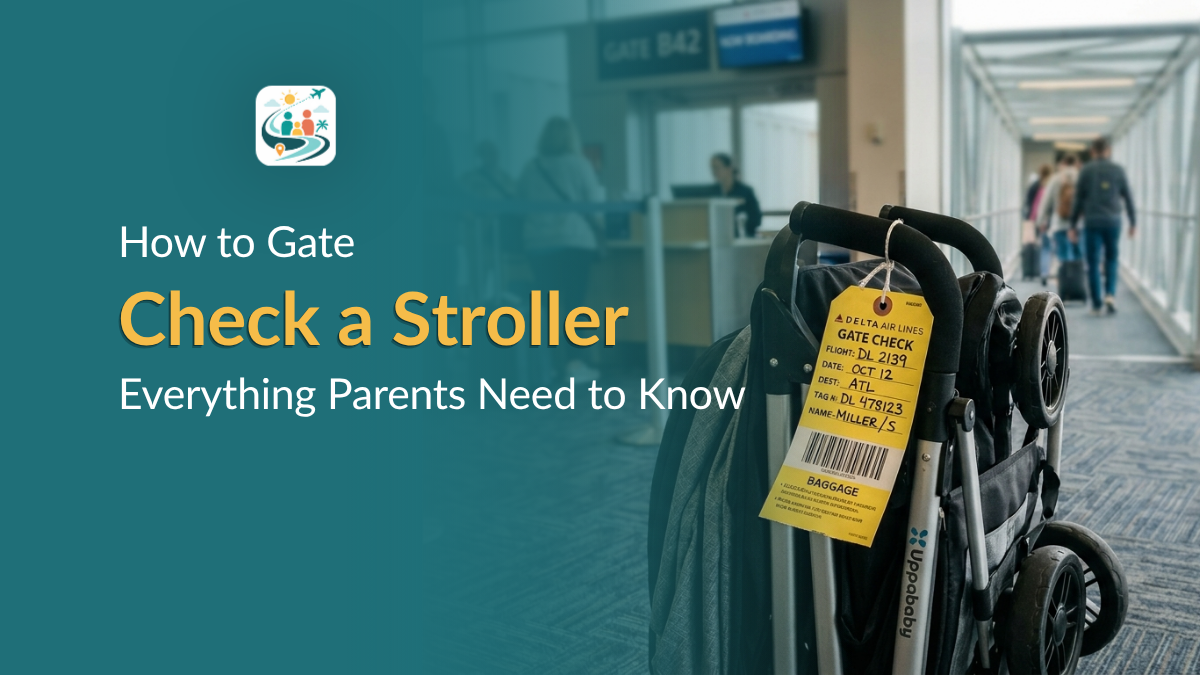
The first time I stood at a boarding gate with a stroller, a baby on my hip, and no idea who to hand anything to, I felt lost. Nobody tells you this part. You research the best travel stroller for weeks, you pack like a pro, and then you’re standing at the jet bridge wondering if you’re supposed to fold it now, tag it yourself, or wait for someone to come to you.
If that sounds familiar, this guide is for you. Gate checking is one of the most parent-friendly things airlines offer. It’s one piece of a bigger picture — our complete guide to flying with a baby or toddler covers the rest of the day, from check-in to landing. It’s usually free, it lets you use your stroller all the way to the plane door, and it comes back to you before you reach baggage claim. You just need to know how it works before you get there, including the parts most guides skip.
What gate checking means

Gate checking means handing your stroller or car seat to airline staff at the boarding gate, not at the ticket counter and not before security. You use the stroller through the entire airport, right up until you step onto the plane.
Before you get to the gate, it helps to know how early you should arrive at the airport with a stroller. It makes the whole process less rushed.
After landing, your stroller comes back one of two ways:
- At the jet bridge. This is the most common and most convenient.
- At baggage claim. Less common, but it happens depending on the flight and airport.
That’s the real difference between gate checking and checking your stroller at the counter. You keep it with you for the whole airport walk, which matters when you have a tired baby and a long terminal ahead of you.
Why parents choose to gate check
It keeps your hands free through security lines, long terminal walks, and gate transfers. A stroller nap during a layover can save an entire trip. When naps don’t happen, airport play areas for toddlers are the next best option. Most airlines allow one stroller per child at no charge. And handing it over at the gate, rather than at the counter, means it’s out of the system for less time and handled less.
Which baby gear can be gate checked
Most airlines accept these at the gate:
- Full-size strollers
- Umbrella strollers
- Travel system strollers
- Car seats
- Booster seats
Many airlines let you gate check a stroller and a car seat together at no cost, but some limit it to one item per passenger. Car seats have their own quirks at the gate — see our guide to gate-checking a car seat. If you’re traveling with both, one may need to go to the ticket counter instead. Airline-by-airline detail is below, because the rules vary more than people expect.
Step by step: how to gate check a stroller
Step 1: prepare your stroller at home
Take five minutes before you leave:
- Remove toys, accessories, and loose items
- Take off cup holders and snack trays if they detach
- Practice your fold once so you can do it fast at the gate
Gate agents move quickly during boarding. Knowing your fold saves time and reduces the chance of rushed handling.
Step 2: use your stroller through security
At the checkpoint, take your child out before the scanner, empty the basket and pockets completely, and follow TSA or airport staff instructions. If you’re carrying formula or milk in the stroller basket, the TSA rules for traveling with a baby explain what gets pulled for extra screening. The stroller goes through the X-ray belt or gets inspected by hand. Once you’re through, reload and continue to your gate. Security is where most stroller confusion happens — here’s the full breakdown of taking a stroller through airport security.
Step 3: ask for a gate check tag at the boarding gate
When you arrive at your gate, ask the agent for a gate check tag, sometimes called a valet tag. They’ll attach it or hand it to you to attach yourself.
Ask them directly: will the stroller come back at the jet bridge or at baggage claim? That one question prevents a lot of confusion after landing, and the honest answer is that it depends on the aircraft and the airport, not just the airline’s general policy.
Step 4: drop off the stroller before boarding
When your group is called, fold the stroller at the top of the jet bridge where staff direct you, leave it in the designated area, and carry your child onto the plane. Staff take it from there.
Step 5: pick up your stroller after landing
Check the jet bridge first. If it’s not there, head to baggage claim. Keep your gate check tag until the stroller is back in your hands. Gate-checked items occasionally take a few extra minutes to offload, especially on busy flights.
Airline policies compared
Every guide tells you to “check your airline’s policy.” Here’s what those policies actually say, pulled directly from each airline’s published baggage and family travel pages as of July 2026. Policies change without notice, so treat this as a starting point and confirm on the airline’s site before you fly.
A few things worth noting about this table. Delta’s own baggage page does not publish a numeric weight cap, even though several third-party stroller guides state one. That gap between what an airline publishes and what blogs repeat as fact is common in this space, and it’s worth checking the airline’s own page rather than a summary site when a specific number matters to your trip.
The “free” misconception
“Free” doesn’t mean unconditional. It usually means one stroller per child, not per adult, and it usually excludes anything you’d classify as a wagon rather than a stroller. United’s policy explicitly separates wagons from strollers and requires wagons to be checked as standard baggage before security, not gate-checked. Southwest doesn’t restrict by weight but will charge an oversized-baggage fee if your folded stroller passes 62 linear inches, which catches out families with double strollers and jogging strollers more often than they expect.
If you’re traveling with both a stroller and a car seat, several airlines (United among them) only waive the fee for one of the two items. The other follows standard baggage rules unless you’ve paid for checked baggage separately.
When “it depends” is the honest answer
Wagon-style and oversized strollers are the clearest example of policy that isn’t uniform even within one airline. A gate agent’s willingness to accept a borderline item can depend on the aircraft assigned to your flight, how full the cargo hold already is, and how busy the boarding process is that day. Published policy sets the outer boundary. What happens at your specific gate on your specific day sits inside that boundary and isn’t fully predictable.
If your stroller is anywhere near a size or weight limit, plan for the possibility of a ticket-counter check instead, and pack accordingly (a baby carrier as backup, discussed below).
Why gate-checked strollers get damaged
A stroller that’s gate-checked doesn’t travel the way your checked luggage does. It’s typically carried down the jet bridge stairs by a ramp agent, staged on the tarmac or in a cart, and loaded into the cargo hold by hand under the same time pressure as everything else happening during boarding. On a rainy or hot day, that means real exposure to weather during the wait, not just handling.
Regional jets add another constraint. The Embraer E170 and E175 have cargo hold doors as small as 31 to 39.6 inches, compared with roughly 48 inches on a Boeing 737 or Airbus A320. If a folded stroller doesn’t fit through that opening, ramp crew can’t load it planeside. It gets routed to oversized checked baggage instead, which means you won’t get it back at the jet bridge even if the airline’s general policy says you should.
Every major US carrier’s contract of carriage disclaims liability for stroller damage. United’s contract states directly that it is not liable for damage to strollers carried as checked baggage, and that excess valuation can’t be purchased for them. Delta, American, Southwest, and Alaska carry similar language. Wheelchairs and mobility devices get separate, stronger protection under the Air Carrier Access Act. Strollers don’t.
What airlines actually cover when a stroller is damaged
Damage claims exist, but the payout process is worth understanding before you’re standing at a baggage service desk with a broken frame.
- US federal rules cap airline liability for damaged baggage at $4,700 domestically (14 CFR 254.4) and 1,519 SDR (roughly $2,000, depending on exchange rates) on international itineraries under the Montreal Convention. That’s a ceiling, not a guarantee of that amount.
- Airlines typically pay depreciated value, not replacement cost. A three-year-old stroller won’t be reimbursed at today’s retail price.
- Cosmetic damage, scuffs, dirty wheels, and general wear are almost never covered, regardless of how well you document them.
- Some parents have reported specific outcomes worth knowing about: a roughly $2,000 UppaBaby Vista damage claim settled for a $100 travel voucher, and a roughly $1,000 Bugaboo claim denied outright under a baby-gear exclusion. These are individual reported cases, not a guarantee of how your claim will go, but they show the gap between what a stroller costs and what an airline may actually pay.
To file a claim: inspect the stroller before leaving the jet bridge or baggage area, photograph any damage on the spot, go to the airline’s baggage service desk before you exit the airport, and file a formal report there rather than by phone later. If the airline denies a legitimate claim, you can escalate to the DOT’s Aviation Consumer Protection division. Keep your gate check tag until the claim is resolved. It’s your proof the item was gate-checked in the first place.
Deciding between gate check, counter check, carry-on, and rental
The right choice depends on your itinerary, not a general rule.
- Connection under 45 minutes. Consider counter-checking instead of gate-checking. A gate-checked stroller on a tight connection is more likely to get separated from you or delayed in transfer.
- Regional jet on any leg. Expect baggage claim return rather than jet bridge, and check your folded stroller’s largest dimension against roughly 33 inches if you know the aircraft type.
- Destination is walkable with easy rideshare access. Renting a stroller at your destination removes airport stroller handling entirely, at the cost of gear that’s usually lower quality than what your child is used to.
- Stroller is a lightweight umbrella model under carry-on dimensions (commonly 22 x 14 x 9 inches). Some airlines let you bring it into the cabin, skipping gate-check risk altogether. Confirm with your specific airline; this isn’t universal.
- Traveling with both a stroller and a car seat, and only one gate-checks free. Decide in advance which one you’re comfortable checking at the counter instead, rather than deciding under pressure at the gate.
- If you’re weighing whether to bring the car seat at all, start with using a car seat on the plane.
Connecting flights: the risk nobody mentions
Multi-leg itineraries introduce a real failure mode: your stroller can be tagged to your final destination instead of your connecting airport, or the reverse, leaving you without it during a layover with a mobile toddler. Our guide to airport layovers with kids covers how to handle that stretch without a stroller. When you drop it off, ask the gate agent explicitly whether it’s tagged to your connection or to your final destination, and say which one you want. On a tight connection, you may prefer it tagged through to your final stop rather than handled again at the connecting gate.
Tips for a smoother experience
- Use a stroller travel bag. It won’t protect against serious mishandling, but it does shield against dirt, grease, and surface scuffs, which are common on jet bridges.
- Label your stroller clearly. A luggage tag with your name and phone number speeds up identification if anything goes wrong.
- Know your fold before you reach the gate. A stroller you can collapse in ten seconds is a different experience from one you’re fumbling with while a gate agent waits.
- Pack a baby carrier as backup. If a stroller delay happens, whether from a tight connection, a regional jet, or a busy baggage area, a carrier means you’re never stuck without a way to hold your child through the terminal. You can also wear your baby through TSA rather than folding the stroller mid-line.
Gate checking vs. ticket counter checking
For most families traveling with babies and toddlers, gate checking is the better experience. If you’re traveling light with a baby carrier and would rather not manage the stroller through security, counter checking is a reasonable choice too.
Frequently asked questions
Usually not. Most US airlines allow one stroller per child at no charge. Confirm with your specific airline, since low-cost carriers sometimes charge for a second item.
Most often at the jet bridge. On regional jets or during busy operations, it may go to baggage claim instead. Ask the gate agent before boarding.
Often, but not always for free. Some airlines only waive the fee for one item, and the other follows standard baggage rules.
It’s rare, but delays happen, especially on connecting itineraries. Labeling your stroller and keeping your gate check tag both help. If there’s an issue, go to the baggage desk before leaving the airport.
No, but it reduces dirt and surface scuffs. Worth it if you fly often.
Usually not, with Alaska Airlines as a notable exception (up to 90 linear inches and 35 lb). Most other carriers require wagons to be checked at the ticket counter as standard baggage.
You can escalate to the DOT’s Aviation Consumer Protection division. Airline liability is capped by federal rule and paid at depreciated value, not replacement cost, so even a successful claim may not cover the full cost of a new stroller.
Final thoughts
Gate checking feels intimidating the first time and routine every time after. Most of the stress comes from not knowing the parts nobody mentions: the airline’s actual weight and wagon rules, what happens if a connection is tight, and what you’re really owed if something breaks.
Show up with a labeled, ready-to-fold stroller, ask for your gate tag, confirm where you’ll collect it, and know your airline’s specific policy before you’re standing at the jet bridge. That covers most of what catches parents off guard.