




Packing for a trip with a baby or toddler often feels harder than the trip itself. Parents worry about forgetting diapers, running out of snacks, or facing a meltdown in a busy airport.
Most of that stress does not come from the child. It comes from not knowing what you’ll need and when. In trips with my kids, the parents who struggled most weren’t the ones with fussy babies. They were the ones who packed without a system.
This checklist gives you that system: what to pack, which bag it goes in, and what to do when something goes wrong. For everything else about the trip itself, see our complete guide to flying with a baby or toddler.
Quick “forget-nothing” master checklist
Use this to avoid last-minute panic. Check each box as you pack.
Save this page. Use the same checklist for your next trip.
The 3-bag system
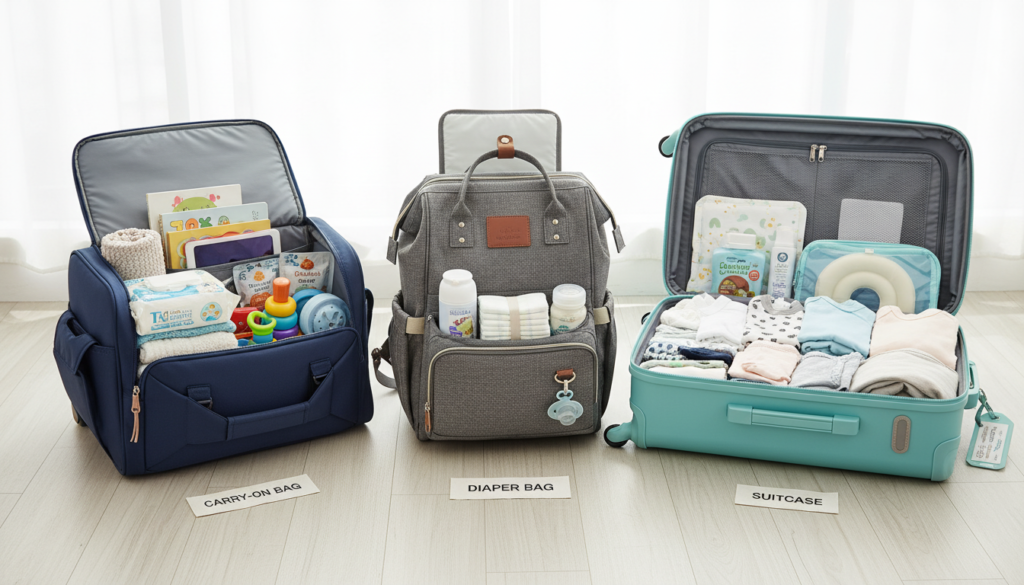
Pack in 3 bags only: a carry-on survival bag, a daily diaper bag, and a suitcase. That’s it.
Trying to organize baby gear into more than 3 categories is how items get lost or double-packed. Fewer bags, clearer rules. Cutting the list down helps too — see what not to pack when traveling with kids.
If your checked luggage is lost, your carry-on bag needs to cover at least one full day on its own.
Toddler travel essentials (pack first)
These come with you no matter what:
- Diapers or pull-ups
- Baby wipes
- Changing mat
- Diaper rash cream
- Two extra outfits for travel day
- Pajamas
- Comfort item (blanket or teddy)
- Stroller or umbrella stroller
- Baby carrier or sling
- Car seat
- Travel documents
The diaper math that actually holds up
Most guides tell you to pack 1 diaper per travel hour plus 2 or 3 extra. That number gets repeated everywhere, but it doesn’t account for two things: age and delays.
A baby under 6 months goes through more diapers per hour than a toddler close to potty training. Cabin pressure and the dry air on planes also change digestion for some infants, which means more frequent changes than at home.
Here’s a version of the formula that adjusts for both:
Add 1 extra diaper for every connecting flight, and 2 more if you have a layover under 45 minutes (you won’t have time to buy any if you run short).
If you do run out mid-trip, most airport shops carry diapers, but expect to pay for a small pack, and not every terminal has one past security. Check before you fly whether your departure and layover airports have a shop that sells baby supplies.
Carry-on survival kit
This bag handles delays, spills, and meltdowns. Keep it under the seat in front of you, never in the overhead bin, so you can reach it without unbuckling.
- Diapers (use the table above)
- Wipes pouch
- Plastic bags
- Change of clothes for baby
- Extra shirt for parent
- Snacks and formula
- Bottles or sippy cups
- Pacifier
- Small toys
- Downloaded cartoons
- Blanket
- Hand sanitizer
- Phone charger
For a fuller breakdown by age, see our carry-on packing list for baby.
Traveling with an older child instead? See the carry-on packing list for toddlers.
The screen time trade-off
“Downloaded shows” sounds like a solved problem until you’re 6 hours in and the tablet is at 4%.
Two things competing lists never mention. First, most seatback outlets on older aircraft are unreliable or don’t deliver enough power to charge a tablet mid-use, so bring a battery pack with at least 5000 mAh, not just a cable. Second, kids who watch a show for 2 hours straight often melt down harder when it ends than if they’d never started, especially during descent when ears are already uncomfortable. Save screens for the middle of the flight, not takeoff or landing, so the “screen ends” moment doesn’t stack on top of the “ears hurt” moment. See toddler ear pressure on flights for how to manage that stretch.
Car seat: bring it, check it, or rent it
This is a real cost-and-risk decision, not just a checklist item.
Our full guide to car seats on airplanes covers the decision in more depth.
If your destination has reliable car seat rental (common at major resorts and through app-based baby gear rental services), renting is often the lower-risk option for a short trip. For a trip longer than 5 days, bringing your own usually costs less overall even with the wear on the seat.
A car seat used for a lap infant on board must be FAA-approved and have a sticker confirming this. Not every seat that fits on a plane seat is approved for use during flight; check the label before you fly.
Diaper and snack quantity guide
Use this for a fast estimate when you don’t want to think through the full table above.
Suitcase packing list
Clothes
- 1 outfit per day
- 1 backup every 2 to 3 days
- Pajamas
- Socks
- Light jacket
Bath items
- Baby shampoo
- Body wash
- Lotion
- Towels (if accommodation doesn’t provide them)
Sleep items
- Travel cot or pack-and-play
- Bed sheet
- Night light
- White noise machine
When your checked bag is lost with the baby gear in it
This happens more than travel guides admit, and almost none of them tell you what to do next.
Airlines are required to reimburse “reasonable” costs for items you need immediately, but they define reasonable narrowly. Formula and diapers usually qualify. A stroller replacement often doesn’t, at least not fully, and you’ll need receipts.
Before you check any bag with baby gear inside, photograph what’s in it. This is the single most useful thing you can do, and almost nobody does it. If a claim gets disputed, a photo showing the car seat and stroller inside the bag at check-in is far stronger than a memory of what you packed.
“24-hour delivery” promises from airlines are optimistic. In practice, delayed bags with baby gear inside can take 2-3 days to arrive, based on my experience. Buy only what you need for the next 24 hours: diapers, formula, one outfit. Don’t rebuy the stroller yet.
Age-based add-ons
0 to 6 months
- Burp cloths
- Swaddles
- Feeding cover
6 to 18 months
- Teething toys
- Soft finger foods
18 to 36 months
- Activity books
- Potty training supplies
Our full baby travel essentials checklist covers the 0–12 month stage in detail.
When the standard list doesn’t apply
Every packing list, including this one, assumes a child with no medical needs, no sensory sensitivities, and no siblings to coordinate with. That’s most families, but not all of them.
If your child has a sensory sensitivity, noise-canceling headphones and a familiar-texture comfort item matter more than any toy on this list. Airports are loud in ways that are easy to underestimate if you haven’t traveled with a sensory-sensitive kid before.
If your child needs medical equipment or refrigerated medication, call the airline’s disability or medical assistance line before you fly, not the general line. Rules for nebulizers, EpiPens, and refrigerated insulin or medication vary by airline and aren’t always listed on the general baggage page. Bring a printed prescription or doctor’s note, since some security officers ask for it even when it’s not technically required.
Packing for twins or multiples isn’t “double everything.” You need double the diapers and clothes, but only one stroller (a double stroller, not two singles) and often just one larger diaper bag rather than two smaller ones, since you’ll only have 2 hands.
See our full guide to flying with twins for the rest of the logistics.
Health and safety
- Thermometer
- Infant pain relief (follow the age and weight instructions on the label)
- First aid kit
- Nail clippers
- Emergency contacts list
- Copies of passport or birth certificate
Sun protection: the part the “6-month rule” leaves out
The standard advice is simple: under 6 months, use shade and clothing; over 6 months, mineral sunscreen is fine. That’s accurate, but it skips the part that actually matters for a beach or pool trip.
Mineral sunscreen tends to rub off faster on an active toddler than the one-line recommendation suggests, especially in water or heavy sweat. Reapply every 2-3 hours during active play, not just once in the morning. If your destination has a high UV index (much of the Caribbean, Southeast Asia, or the Southwest US in summer), plan for more frequent reapplication than you would at home, and consider a rash guard for the hours you can’t reapply on schedule, like during a nap or a long car ride.
For flights, airlines may ask for proof of age for a lap infant. Bring the birth certificate or passport, not just a photo of it on your phone; some gate agents want the physical document. See flying with a lap child for the full rules and costs.
Mealtime packing
- Bottles and nipples
- Formula or breast pump
- Bibs
- Spoons and bowls
- Sippy cups
- Snacks (extra for delays)
- Cooler bag
- Thermos
- Travel highchair
- Bottle brush
Play time and calm toys
Bring a few toys and rotate them rather than packing many at once. A toy your child hasn’t seen in a few weeks holds attention longer than 5 toys they see every day.
- Small toys
- Coloring book
- Stickers
- Story book
- Favorite comfort toy
Essentials for beach, lake, and cruise vacations
- Swimsuit
- Swim diapers
- Sun hat
- Sunglasses
- Rash guard
- Beach towel
- Beach shelter
- Sand toys
- Waterproof stroller cover
- Disposable ponchos
For a beach trip specifically, see beach travel with babies and beach essentials for babies.
Renting bulky gear vs. bringing it
“Rent the bulky stuff” is common advice, but the math depends on the trip.
Rental reliability is the real risk, not the price. A no-show delivery on day 1 of a trip is worse than the cost difference. If you rent, book from a company with same-day backup support, and confirm delivery the night before, not just at booking.
Trip-type add-ons
Flying
- Pacifier for takeoff
- Extra snacks
- Backup outfit
Road trip
- Window shades
- Travel pillow
- Toy rotation bag
Hotel stay
- Night light
- Door stopper
Airbnb stay
- Dish soap
- Laundry kit
International travel
- Extra medicine
- Printed prescriptions
- Plug adapter
Lap infant age cutoffs: what happens if your baby turns 2 mid-trip
Airlines require a paid seat for any child 2 or older, including on the return leg of a trip. If your baby’s second birthday falls between your departure and return dates, you need to buy a seat for the way back, and not every airline flags this automatically when you book.
Policies vary by carrier on exactly how they verify age at check-in, so confirm directly with your airline before booking a trip that spans a birthday, rather than assuming it’ll get sorted at the gate. Buying the return seat in advance is usually cheaper than doing it last-minute at the airport.
What not to pack
Most parents overpack these:
- Too many toys
- Full diaper boxes
- Large medicine kits
- Bulky gear you can rent
- Large food supply
When overpacking is actually the right call
Packing light is good advice for most trips, but not all of them.
If your baby is formula-fed and you’re traveling somewhere the same brand isn’t sold (common outside North America and Europe), bring a full trip’s supply. Switching formula brands mid-trip can cause digestive upset, and that’s a bad problem to introduce while traveling.
If you’re going somewhere remote, or somewhere without reliable laundry access, bring more clothing than the “1 outfit per day” rule suggests. The assumption behind packing light is that you can buy what you’re missing. That assumption breaks down outside major cities.
Packing timeline
1 week before Wash clothes and check that documents are current.
Night before Pack bags and charge devices.
Morning of travel Add fresh snacks and do a final diaper bag check.
Last-minute panic check (60 seconds)
Before you leave the house:
- Diapers and wipes in carry-on
- Snacks packed
- One backup outfit for child
- Phone and charger
- Comfort toy or pacifier
- Travel documents
After the trip: resetting for the next one
Most packing guides stop at departure. The next trip gets easier if you handle a few things right after you land.
Sanitize bottle parts and pacifiers as soon as you’re home; airport and plane surfaces carry more germs than your kitchen. Replace anything that ran low during the trip (wipes, rash cream, batteries) before it goes back in the bag, not the night before your next trip. Check your stroller and car seat for wear from gate-checking; a cracked wheel or frayed strap is easier to catch at home than at security.
If you travel more than once or twice a year, keep a permanent “go-bag” stocked with travel-size versions of the basics: diapers, wipes, a spare outfit, a travel first aid kit. Restocking it once after each trip is faster than repacking from scratch every time.
Related Guides
By age: Baby travel essentials checklist · Toddler travel essentials checklist
For the flight: Carry-on packing list for baby · Carry-on packing list for toddlers
Pack lighter: What not to pack when traveling with kids
Final thoughts
Packing for a baby or toddler gets easier once you stop treating every trip like the first one. Use this list before your next trip, adjust the amounts for your child’s age, and keep a few sections in mind that most checklists skip: the diaper math, the lost-bag plan, and the age cutoff for lap infants. Those are the details that actually cause problems.


