Planning a family trip should feel exciting. A small voice keeps asking hard questions. What if my child gets sick before the flight? What if we end up in a hospital overseas? What if I have to cancel and lose thousands of dollars? When you’re traveling with children, the risk is bigger. You’re responsible for your child’s safety in a place you may not know.
I’ve seen families deal with surprise medical visits abroad, sudden trip cancellations, and hospital bills in countries where they didn’t speak the language. Most parents said they never expected it to happen to them. Travel insurance doesn’t assume the worst. It means you understand the risks before you leave and have support if something unexpected happens. For a broader look at keeping your family safe on any trip, see our guide to family travel safety for babies and toddlers.
Quick takeaway for parents
Family travel insurance is usually worth it when you’re traveling outside the U.S., booking non-refundable trips, or traveling with young kids. It helps with medical emergencies, cancellations, delays, and emergency evacuation.
- Buy it if your trip is expensive, international, or mostly non-refundable.
- Consider skipping it for short domestic trips with refundable bookings.
- Most important: medical and evacuation coverage for kids.
What is family travel insurance?
Family travel insurance is one policy that covers your whole family during a trip. You don’t buy separate policies. The entire family is covered together.
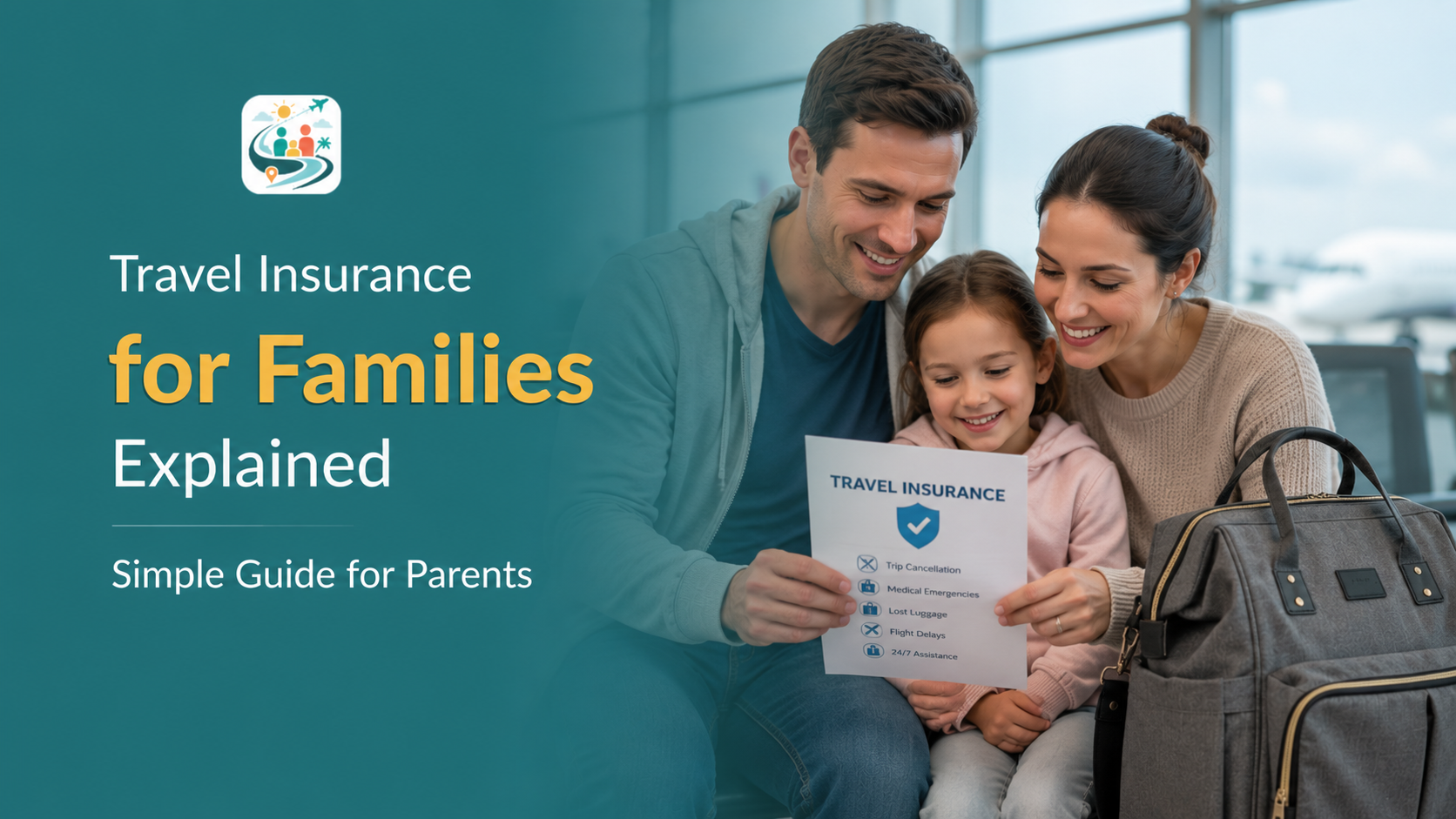
It protects against medical emergencies, trip cancellation, travel interruption, lost baggage, and emergency evacuation.
What it covers — and what each part actually does
| Coverage type | What it actually does for your family |
| Emergency medical care | Pays for doctor visits, hospital stays, medicine, and ambulance services abroad. Most plans cover $100,000–$500,000 per person. |
| Emergency evacuation | Flies your child to a better hospital or home if local care isn’t adequate. Without insurance: $25,000–$250,000. For real-world context on what medical care looks like abroad, see our guide to is Aruba safe for families — it covers healthcare access, pharmacy gaps, and what a medical visit actually costs on an island destination. |
| Trip cancellation | Refunds prepaid, non-refundable bookings if a covered reason forces you to cancel before departure. |
| Trip interruption | Covers the unused portion of your trip plus extra costs to get home if you have to leave early. |
| Travel delay | Pays for meals and hotel when delays run 6–12+ hours, depending on your policy. |
| Baggage loss | Reimburses lost or stolen bags. Limits are usually $1,000–$2,500 per person, with sub-limits per item. One of the more common family claims is a damaged car seat — see what to do if your car seat is damaged after a flight for how to document and file that claim. |
Why your existing coverage probably isn’t enough
Most parents assume their health insurance or credit card handles travel emergencies. Here’s what each one actually does:
| Coverage type | U.S. health insurance | Credit card benefit | Travel insurance |
| Emergency medical care abroad | Rarely. Medicare: nothing. Most ACA plans: nothing outside the U.S. | Almost never | Yes — up to policy limit |
| Emergency evacuation | No | No | Yes |
| Trip cancellation | No | Sometimes — capped at $1,500–$10,000 | Yes — full trip cost |
| Travel delay expenses | No | Sometimes — $500 cap typical | Yes |
| 24/7 assistance abroad | No | No | Yes — insurer coordinates care |
Note on employer health plans: Coverage abroad varies by plan. Call your insurer before traveling and ask specifically: “Does my plan cover emergency hospitalization outside the United States, and does it require pre-authorization?” Get the answer in writing.
The pre-existing condition trap — what parents almost always get wrong
This is the single most common reason family travel insurance claims get denied or cut. Most parents don’t discover the problem until they’re trying to file.
Here’s how it works. Every policy has a look-back period — typically 60 to 180 days before your purchase date. If your child received medical attention for a condition during that window, the insurer treats it as pre-existing. That includes a pediatrician visit for a recurring cough, a prescription refill for mild asthma, or a past ER visit for a high fever.
What trips families up:
- They don’t think of routine pediatrician visits as “medical treatment”
- They assume conditions need a formal diagnosis to count — they don’t
- They buy the policy weeks after the deposit, missing the waiver window
| Term to know | What it means in plain language |
| Look-back period | The window of time before purchase (60–180 days) during which any medical contact can define a condition as “pre-existing” |
| Pre-existing condition waiver | An add-on that removes pre-existing exclusions entirely — but must be purchased within 14–21 days of your first trip deposit |
| Acute onset provision | Some policies cover a sudden flare-up of a pre-existing condition even without a waiver — check if yours has this before assuming you’re excluded |
| Stable condition requirement | Many policies require the condition to be “stable” (no medication changes, no new treatment) for 60–180 days before travel |
Real scenario: ear infection claim — two different outcomes
The situation: A 6-year-old had two ear infections in the 4 months before a Mexico trip. On day 3 of vacation, she develops a new ear infection and needs a doctor and antibiotics.
Without a waiver: The insurer reviews the look-back period, finds the prior ear infections, and classifies the new infection as a pre-existing condition. The $340 claim is denied.
With a waiver (purchased within 14 days of deposit): Pre-existing exclusion is removed. The $340 claim is paid in full.
The fix: Buy the policy within 14 days of your first trip payment. That’s the only window when a waiver can be added.
Timing traps that void valid claims
A family can have a genuine, covered emergency and still receive nothing. These are the procedural failures that kill otherwise valid claims — and none of them are mentioned in standard guides.
| The mistake | What actually happens to your claim |
| Calling your doctor at home before calling the insurer’s assistance line | Triggers a “failure to notify” clause. Some insurers reduce reimbursement by 25–50% or deny entirely. |
| Going to an unapproved hospital without pre-authorization | Reimbursement drops to “reasonable and customary” rates — which may be half what the foreign hospital charged. |
| Filing the claim after you return home, more than 90 days later | Most policies have a 20–90 day post-trip filing window. Miss it and the claim is void regardless of the event. |
| Paying the hospital bill with a credit card before contacting the insurer | Creates a documentation chain that complicates direct billing. Always contact the insurer before paying if possible. |
| Getting verbal approval from the assistance line without written confirmation | Verbal approval isn’t a coverage guarantee. Ask for confirmation by email or text before proceeding. |
The correct sequence: Insurer assistance line first — then hospital. Even 10 minutes in a waiting room is enough time to make that call. Document that you made it.
What happens if your child gets sick abroad
If your child gets sick abroad: what to do
| 1 | Call the 24/7 assistance number | Do this before going to any hospital. The insurer needs to guide the process from the start. Document the call time. |
| 2 | Go to the approved hospital | The insurer directs you to a vetted facility. Using an unapproved one without authorization reduces reimbursement. |
| 3 | Get written pre-authorization | Ask the insurer to confirm coverage in writing — email or text. Verbal approval is not enough. |
| 4 | Collect every document | Diagnosis notes, receipts, prescriptions, pharmacy receipts, test results. Ask for English translations at the facility. |
| 5 | Submit your claim promptly | Most insurers require submission within 20–90 days of returning home. File as soon as you’re back. |
The “free child” pricing — what it actually means
Many insurers advertise that children travel free or at a steep discount under a family policy. That’s often true — but the structure has details worth understanding before you buy.
| What “free child” usually means | What to check before assuming |
| Children under 17 (sometimes 21) travel free on one policy | Confirm the age cutoff for your insurer. It varies from under 17 to under 21 depending on the plan. |
| Most plans cover 2–3 children free per policy | If you have 3 or more children, check whether all are covered or whether you need an additional premium. |
| Medical limits for free children may be lower | Some policies cap children at $50,000 medical while adults get $250,000. Read the schedule of benefits, not just the headline. |
| Annual multi-trip policies have trip duration caps | Most cap individual trips at 30–45 days. A longer trip requires a single-trip policy regardless of cost comparison. |
When travel insurance is worth buying
| Your situation | Recommended? | Why |
| International trip with children | Yes | U.S. health insurance covers little or nothing abroad. Evacuation alone can exceed $100,000. |
| Kids under 10 | Yes | Young children get sick unpredictably. A single ER visit in Mexico or Europe can cost $2,000–$8,000 without insurance. |
| Non-refundable trip over $3,000 | Yes | Insurance premium runs 4–8% of trip cost. At this level the math usually favors buying it. |
| Child with any prior medical history | Yes — with waiver | Buy within 14 days of your first trip deposit to qualify for pre-existing condition waiver. |
| Refundable domestic trip | Maybe | Lower financial exposure. Your domestic health plan likely covers medical emergencies inside the U.S. |
| Short domestic trip, all bookings refundable | Skip | The premium cost likely exceeds the risk you’re transferring. Self-insure. |
Cost reality
A family of 4 on a $5,000 international trip typically pays $150–$350 for a solid policy — around 3–7% of trip cost. Here’s what that premium covers you against:
| Emergency | Possible cost without insurance |
| ER visit (minor illness, e.g. ear infection) | $300 – $2,000 |
| Hospital admission (serious illness) | $5,000 – $15,000+ |
| Surgery abroad | $10,000 – $100,000+ |
| Medical evacuation (e.g. Bali to home) | $80,000 – $250,000+ |
| Trip cancellation (non-refundable bookings) | Full trip cost — typically $3,000–$12,000 for a family |
Before you buy: 6 questions to ask every insurer
Most parents pick a policy based on price. These questions determine whether the policy actually works when you need it.
Questions to ask before purchasing
| 1 | What is your look-back period for pre-existing conditions? | If your child has any medical history in the past 6 months, this answer determines whether you need a waiver. |
| 2 | Does this policy include an acute onset provision? | This covers sudden flare-ups of pre-existing conditions even without a waiver. Some policies have it, many don’t. |
| 3 | What are the medical coverage limits for children specifically? | Ask for the schedule of benefits. Children’s limits are sometimes lower than adults’ on the same policy. |
| 4 | Is pre-authorization required before hospital treatment? | If yes, you must call the assistance line before going to a hospital or reimbursement may be reduced. |
| 5 | What activities are excluded from child coverage? | Snorkeling, zip-lining, horseback riding, and jet skis are excluded on many standard policies. Confirm before your trip includes these. |
| 6 | How many days after returning do I have to file a claim? | Ranges from 20 to 90 days. Missing this window voids the claim regardless of the event. |
Conclusion
Problems are rare. When they happen, they get overwhelming fast. Travel insurance doesn’t stop illness, delays, or accidents, but it gives families financial protection and a clear process during a stressful moment.
Two things matter more than anything else: buy the policy within 14 days of your first trip deposit so you can qualify for the pre-existing condition waiver, and call the insurer’s assistance line before you go to any hospital abroad. Those two actions protect the vast majority of claims that would otherwise be denied on a technicality.
Before your next trip, ask yourself honestly: if your child needed medical care tonight in another country, would you feel confident handling it alone? If that question makes you uneasy, the cost of insurance stops being the main consideration. For practical preparation before you leave home, see our guide to travel documents for infants and our complete guide to traveling with toddlers.