



The first time I flew with a baby, takeoff felt overwhelming. I worried about ear pain, crying, and people staring. I kept asking myself the same questions many parents ask: When should I feed? What if my baby isn’t hungry? What if nothing works? Conflicting advice online only made it worse.
After multiple flights with babies, one thing became clear: you don’t need perfect timing. You need calm guidance and flexible options.
For the complete overview of flying with a baby or toddler, including everything beyond feeding, see our full guide.
Why babies feel ear pressure on a plane
Air pressure changes quickly when a plane climbs or descends. Adults can clear this pressure by yawning or swallowing, but babies can’t do this on their own. Their Eustachian tubes are shorter, more horizontal, and less muscularly developed than an adult’s, so pressure equalizes more slowly and less reliably.
This is why some babies show no signs of discomfort while others cry through the entire descent. Individual anatomy varies. The approach of offering sucking and swallowing to help equalize pressure is supported by the American Academy of Pediatrics.
This pressure can cause:
- Ear discomfort
- Fussiness
- Crying
Why feeding helps during takeoff and landing
Swallowing triggers the small muscle that opens the Eustachian tube, which lets pressure equalize between the middle ear and the cabin. This doesn’t require a full feed. A few minutes of comfort sucking is enough.
You can use breastfeeding, a bottle, or a pacifier. All three work.
For a deeper look at how feeding helps relieve ear pressure in babies, including what to expect at different ages, see our dedicated guide.
Why descent causes more discomfort than takeoff
Descent causes more ear discomfort than takeoff for most babies. During descent, cabin pressure rises faster than middle-ear pressure can equalize passively, which creates a pressure difference against the eardrum. The effect is stronger and lasts longer than the pressure change during ascent.
If you can only focus on one moment in the flight, focus on descent.
When to start feeding
During takeoff: Start feeding as the plane begins to lift off. Starting during boarding is too early — your baby may finish or lose interest before the pressure change actually begins.
During descent: Don’t wait for the pilot’s announcement. On many flights — especially short ones under 90 minutes — pressure changes begin before any announcement is made. A more reliable cue: when the flight map shows roughly 40–45 minutes to your destination, descent is likely starting or imminent. On a flight shorter than 90 minutes, be ready to feed within 20 minutes of reaching cruising altitude.
Slow, calm feeding works best during descent. If the feed ends before landing, switch to a pacifier or offer small sips.
Quick takeaway: feeding during takeoff & landing
- Descent matters most. Offer feeding or sucking during the final approach.
- A few minutes of sucking is enough. Your baby doesn’t need to finish a feed.
- Breast, bottle, and pacifier all work equally.
- Don’t force feeding. If your baby refuses, move to a backup.
- Your calm matters. Infant co-regulation is real — a parent who is visibly anxious makes it harder for a baby to settle.
What to do during takeoff & landing
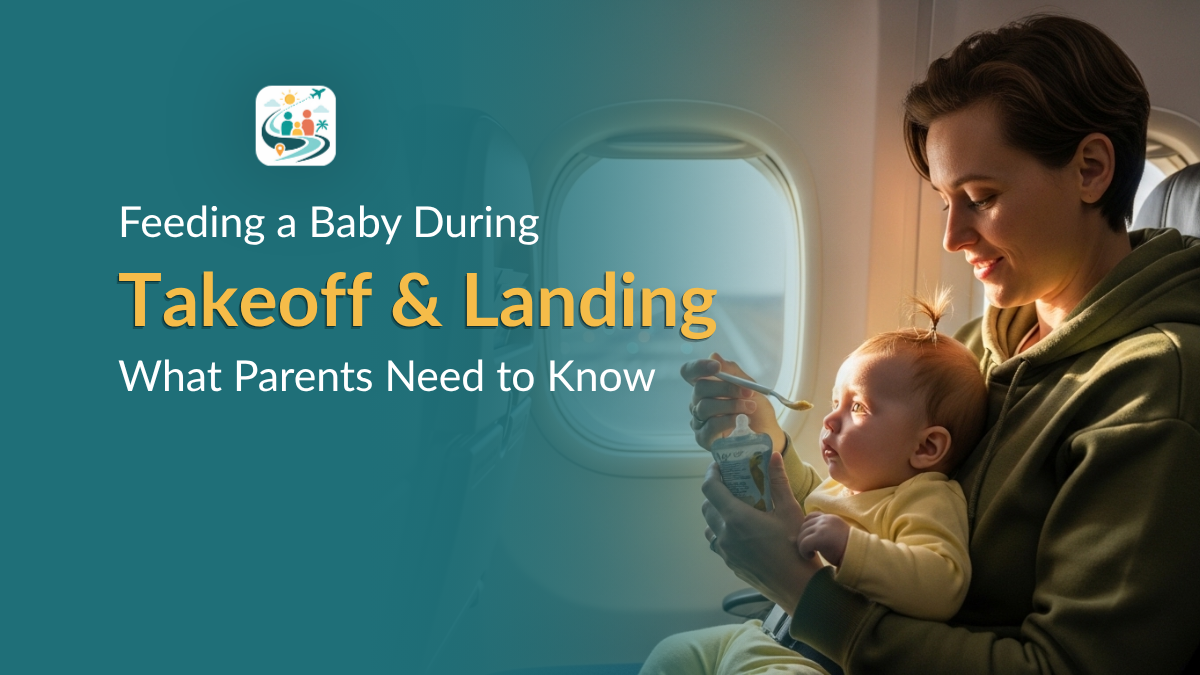
Breastfeeding during takeoff and landing
Breastfeeding works well on planes. If you’re flying with a newborn for the first time, we cover everything specific to those early weeks in a separate guide.
A few things that help in a plane seat:
- Window seat gives the most privacy and elbow room
- A rolled airline blanket under your elbow replaces a nursing pillow
- Keep movements slow — airports are stimulating and a fast or abrupt latch attempt often fails
If your baby unlatches, don’t worry. Try again gently. The sucking doesn’t need to be continuous to help.
Bottle feeding during takeoff and landing
Bottle feeding is equally effective. A few things to keep in mind:
- Hold your baby upright, not reclined
- Keep the bottle slightly angled so the nipple stays full
- Never prop the bottle — this is a choking risk at any altitude
- If turbulence starts, close or remove the bottle and switch to a pacifier. One hand on the bottle during turbulence means no free hand for the baby.
On warming: Most airlines will provide hot water for warming a bottle if you ask during boarding — not during descent, when you won’t have the time or the hands. If your baby strongly prefers warm milk, test cold-bottle tolerance before the flight. A baby who refuses cold milk on the ground will refuse it at 35,000 feet too.
Breast, bottle, or pacifier — which to use
Breastfeeding, bottle feeding, and pacifiers all relieve ear pressure through the same mechanism: sucking and swallowing. There’s no hierarchy. Use whatever your baby accepts in that moment.
One thing to confirm before you fly: if you’re planning to rely on a pacifier as your primary backup, make sure your baby still takes it. Babies who accepted a pacifier at 2 months sometimes reject it by 5 or 6 months. Find out before you board.
If you’re feeding a lap infant mid-flight, our lap child guide also covers positioning and practical tips for keeping your baby comfortable in your arms throughout the journey.
Feeding is for comfort, not nutrition
Feeding during takeoff and landing isn’t about calories. It’s about the physical act of sucking and swallowing. Your baby doesn’t need a full feed. They don’t need to finish a bottle. Don’t force it.
What if feeding doesn’t work
This happens, and it doesn’t mean you did something wrong.
First, try the backups: pacifier, a clean finger for sucking, small sips of milk or water (for babies old enough). Even 60–90 seconds of sucking can take the edge off.
If everything is refused: most babies’ ears will equalize on their own within a few minutes of the pressure stabilizing after landing. The most intense pressure phase is roughly the last 10–15 minutes of descent. It typically clears within 5 minutes of touchdown. Crying during this window, while distressing to witness, is not a sign of harm.
What helps in the meantime: firm rhythmic patting on the back, skin-to-skin contact if possible, a familiar voice close to the baby’s face. Slow your own breathing first — it’s a real behavioral intervention, not just reassurance. Babies in distress are highly sensitive to the physical cues of the adult holding them.
After landing, watch for:
- Crying that continues or escalates past 15–20 minutes after touchdown
- Pulling at one specific ear (not both — habit ear-pulling is common, but one-sided pulling combined with continued distress is more meaningful)
- Fever developing within 12–24 hours
- Baby inconsolable in a way that doesn’t match their usual cry patterns
If any of these appear, see a pediatrician within 24–48 hours. Some babies discover an undiagnosed ear infection only when a flight triggers significant pain.
Should you wake a sleeping baby?
No. Sleeping babies often handle pressure without distress — muscle relaxation during sleep allows some passive Eustachian tube movement, and sleeping babies don’t register and react to discomfort the same way an alert baby does.
If your baby wakes and cries, offer feeding or a pacifier then.
FAQ: feeding a baby during takeoff & landing
Do I have to feed my baby during takeoff and landing? No. It’s the most reliable way to help with ear pressure, but it’s not mandatory. Sleeping babies often manage fine without it. If your baby is calm and settled during ascent or descent, there’s no reason to interrupt them.
Does feeding prevent ear infections? No. Feeding helps with pressure discomfort during flight. It doesn’t prevent ear infections, which are caused by bacteria or viruses, not by cabin pressure.
What if my baby refuses everything? Try a pacifier, a clean finger, or small sips if your baby is old enough. If all of those fail, know that most healthy babies’ ears will equalize on their own once the pressure stabilizes. The crying feels alarming but usually clears within minutes of landing. If distress continues past 15–20 minutes after touchdown, see a pediatrician.
Safety checklist for feeding on a plane
- Don’t force feeding
- Keep your baby upright during bottle feeding
- Never prop the bottle
- Close or remove the bottle when turbulence starts — switch to pacifier
- Request warm water for bottle warming during boarding, not during descent
- Follow seatbelt signs; position yourself and your baby before descent begins so you’re not scrambling when the sign goes on
Babies with colds or ear infections
A baby with active congestion has a higher risk of ear discomfort during flight. Swollen mucous membranes narrow the Eustachian tube further, which makes swallowing-triggered equalization less effective. Feeding still helps, but it may not fully resolve the discomfort.
Feeding doesn’t prevent ear infections. If your baby has a recent ear infection, congestion severe enough that they can’t breathe through their nose, or a history of ear surgery, speak to a pediatrician before the flight.
Decongestants aren’t a safe option for babies. The FDA warns that children under 2 should never be given any cough or cold product containing a decongestant, citing risks including seizures and rapid heart rate. The American Academy of Pediatrics advises avoiding these medicines in young children generally, and recommends saline drops and gentle nasal suction instead. Don’t give a decongestant for flight ear pain without a pediatrician’s explicit direction.
Final thoughts
There’s no perfect flight. Some feeds work, some don’t, and a baby who screamed through descent on one trip may sail through the next one. The variables — age, congestion, Eustachian tube anatomy, how tired the baby is — change every time.
What stays constant: feed during descent if you can, have a backup ready, stay calm, and don’t interpret a rough landing as a failure. You’re prepared. That’s what matters.