


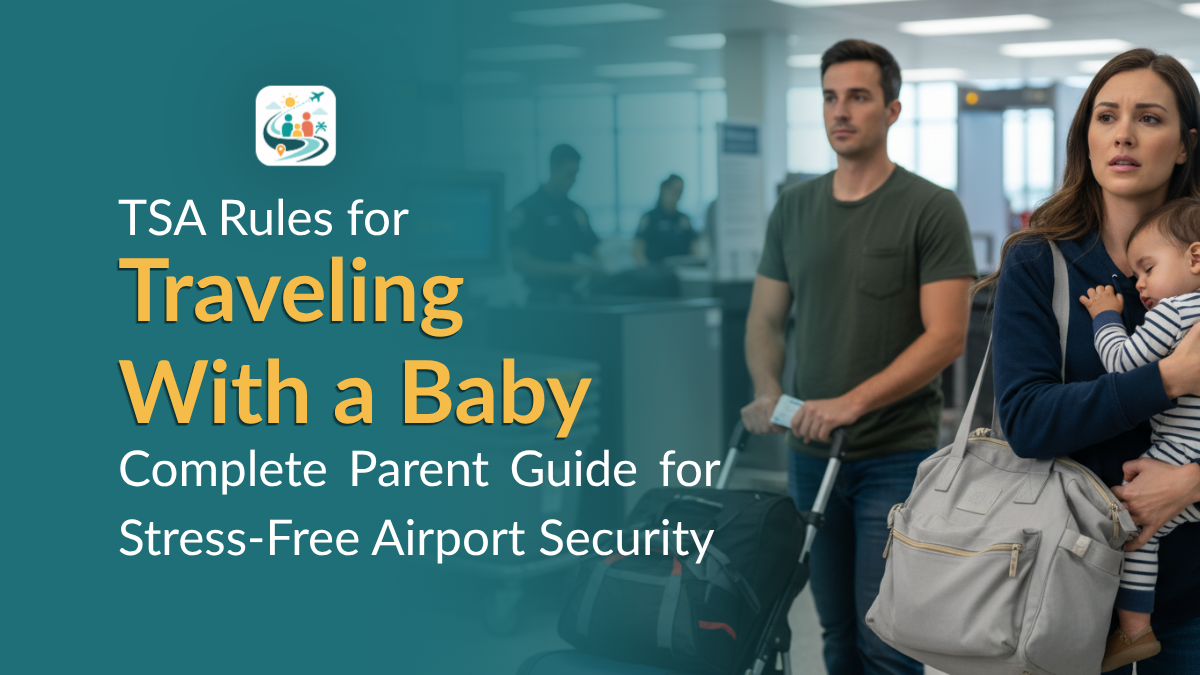
I still remember standing in the security line on my first flight with a newborn, trying to hold her, manage the diaper bag, and figure out if TSA was about to take the milk I’d spent hours pumping. Nobody had told me what to expect. That uncertainty is what makes the TSA checkpoint feel so high-stakes for new parents — not the rules themselves, but not knowing them.
After traveling multiple times with infants and toddlers, I learned the process is manageable once you know what’s coming. This guide covers verified TSA rules alongside what I’ve actually experienced at the checkpoint: what to declare, how to pack, what screening looks like, and what to do when things don’t go according to plan.
One scope note: these rules apply to US domestic airport security. If you’re flying internationally, check the rules for your departure country separately. They don’t always match TSA policy, and several countries strictly enforce the 100ml liquid rule with no breast milk exemption.
TSA baby travel rules: quick takeaway
- TSA allows breast milk, formula, and baby food over 3.4 oz when traveling with a baby
- Declare baby liquids to the TSA officer before your bags go through the scanner
- Ice packs and gel packs are allowed to keep baby feeding liquids cold — frozen solid passes faster than partially thawed
- Powdered formula and baby powder may get extra screening
- Strollers and car seats must be screened at the checkpoint
- Kids under 18 don’t need ID for domestic flights (adults do)
- TSA allows expressed breast milk even if your baby isn’t traveling with you
TSA rules for traveling with a baby: the basics
TSA manages airport security in the United States. Baby feeding supplies are exempt from the standard 3.4-ounce liquid rule.
Parents can bring these items through security in reasonable quantities:
- Breast milk
- Baby formula
- Toddler drinks
- Baby food and puree pouches
- Medically necessary liquids
- Cooling packs and gel ice packs
Declare these items at the checkpoint before your bags go on the belt. TSA may inspect them with swab testing or a visual check.
TSA rules for baby items: what’s allowed
Pack baby liquids together and declare them before your bags go through.
Before you reach security
Arrive early. With baby gear and declared liquids, the checkpoint takes longer than a standard adult screening. At a busy airport during morning peak hours, add at least 30 extra minutes beyond what you’d normally budget.
- Put all baby liquids into one pouch or clear bag
- Remove loose items from stroller baskets
- Have boarding passes and ID ready before you reach the lane
- Pack a comfort item or snack for the security line itself
Efficient packing for TSA screening
How you pack your diaper bag directly affects how long you spend at the checkpoint. A densely packed bag — rolled clothes, pouches, tubes, and toys all mixed together — creates a complicated X-ray image that officers flag for manual review, even when nothing inside is prohibited. The bag’s visual complexity triggers the delay, not the contents.
Pack to simplify what officers see on the X-ray:
Keep together in one easy-to-pull pouch:
- Bottles and formula
- Breast milk containers
- Baby food pouches
- Cooling packs
Keep baby liquids separate from adult toiletries. Keep metal items (snap buckles, utensils, tube caps) out of the main diaper bag compartment where possible — metal clusters in a dense bag consistently trigger secondary review.
When you reach the belt, pull the baby liquids pouch out and place it separately. The bag image is simpler without it, and the officer can assess the liquids before the bag clears the belt. This one step reduces manual review more than any other packing choice.
Use your stroller as a rolling organizer
Strollers must be screened, so keep the basket neat. Loose items scattered in the basket slow down screening. Small storage bags or a packing cube in the basket keeps everything retrievable quickly.
Step-by-step TSA checkpoint walkthrough
Here’s what the process usually looks like:
- Remove baby from the stroller or carrier
- Pull out the baby liquids pouch and set it aside
- Put bags, stroller (folded if asked), and baby gear on the conveyor belt
- Tell the TSA officer you have baby liquids before anything goes through
- Walk through the scanner while holding your baby
- TSA inspects baby liquids separately — swabbing containers or doing a visual check
- Pick up your items and repack past the checkpoint
If you don’t want breast milk X-rayed, you can request alternate screening. TSA is required to offer this. The alternate process takes a few minutes longer but is an option if you’re uncomfortable with the milk going through the scanner.
Strollers
Small strollers may go through the X-ray belt. Larger ones get a manual check. Either way: remove the baby first, fold the stroller if asked, and clear the basket of loose items before you reach the lane.
Babywearing
Carriers and slings are generally allowed through screening. Many parents walk through the scanner while wearing the baby. Whether you’ll be asked to remove the carrier depends on the type and the officer.
Structured carriers with metal buckles (Ergobaby, Baby Bjorn-style) flag differently from ring slings or soft wraps. Metal hardware triggers the scanner. When I’ve worn a ring sling, I’ve walked through without removing it. When I’ve worn a buckle carrier, I’ve been asked to step aside for a pat-down about half the time.
If you’re traveling solo with a newborn and can’t safely remove the carrier alone, tell the officer before you reach the scanner. You can request a pat-down as the alternate screening method. Don’t wait until you’re through the machine to raise the issue — bring it up at the document check.
Car seats
Car seats are allowed and must be screened. TSA may X-ray them or inspect by hand. You can bring a car seat on board if your child has their own ticket, or check it, or gate check it.
Breast milk, formula, and ice packs
TSA allows breast milk, formula, toddler drinks, and baby food in reasonable quantities. “Reasonable quantity” is TSA’s own language and they don’t define it in ounces. Officers use visual judgment. In practice, I’ve carried 12 oz without a second glance and seen other parents questioned at 20 oz. The more you’re carrying, the more helpful it is to have a quick explanation ready: “I’m traveling for four days and pumping.”
Declare baby liquids before your bags go through. Keep them easy to reach. Expect extra screening sometimes — it’s standard procedure, not a sign you did something wrong.
TSA can open breast milk containers for inspection if needed. If you’re uncomfortable with that, you can request that they not open the containers and instead use alternate screening methods (typically additional swab testing of the outside). This is your right under TSA policy. Know it before you reach the checkpoint.
Ice packs and the frozen-solid rule
Frozen solid packs screen fastest. Partially thawed or slushy packs get extra review. TSA classifies ice packs in their current physical state: solid gets waved through with the milk, partially liquid may be subject to the standard liquid rules for the liquid portion.
If your packs have been in a bag for 90 minutes before you clear security, they may not be frozen solid anymore. To keep them colder longer: freeze packs flat (more surface contact with the milk containers), use insulated pouches rather than loose packs in a bag, and pack the milk-and-packs pouch at the top of your bag where it stays colder than at the bottom near your back.
If your ice packs are confiscated at the checkpoint: most airports past security have stores that sell ice or cold packs. Nurses’ stations or family rooms sometimes have ice as well. It’s recoverable — inconvenient, but not a trip-ender.
Traveling with breast milk without your baby
TSA allows expressed breast milk regardless of whether your baby is on the flight. If you’re a pumping parent traveling for work, the checkpoint interaction is slightly different — there’s no baby present to establish visual context for the officer. A quick, direct statement works: “I’m traveling without my baby and bringing back pumped milk.” You don’t need documentation. No pediatrician’s note is required. But having that sentence ready speeds things up.
Quick TSA baby liquids decision guide
TSA powder screening
Powdered formula and baby powder are allowed. Larger amounts consistently get extra screening — usually swab testing or a visual check. Pack powder in its own container or bag, separate from the rest of the diaper bag, so it’s easy to pull out without unpacking everything.
What to do if TSA applies the wrong rule
TSA officers have discretion within policy, and occasionally an officer applies the liquid rule to an item that’s exempt. If that happens at your checkpoint:
Step 1: State the policy calmly and specifically. “Breast milk is exempt from the 3.4-ounce limit under TSA’s medically necessary liquids policy.” Don’t argue — state it once, clearly.
Step 2: Ask for a supervisor if the officer doesn’t resolve it. The phrase is: “I’d like to speak with a supervisor, please.” This is a normal request and officers are required to comply.
Step 3: If there’s no time to escalate at the airport — you have a flight to catch — note the officer’s badge number, the airport, the date, and what was said. File a complaint with the TSA Contact Center after your flight. Complaints about confiscated breast milk have resulted in policy reminders at specific airports.
What not to do: refuse to comply, touch the equipment, or film the officer directly. Any of these escalates the situation and delays everyone. Make your case with words, stay calm, and escalate through the proper path.
The @AskTSA account on X (Twitter) responds to real-time questions. If you’re in the airport and unsure about a specific item, a quick tweet often gets a response within minutes. I’ve used this.
Managing checked baggage
TSA doesn’t control checked baggage policy — airlines do. Keep the decision simple: your most important baby items travel in your carry-on. That means diapers, wipes, feeding supplies, spare clothes, and anything time-sensitive.
Bulky items (extra diapers for a longer trip, a travel crib, large gear) can go checked. Label strollers and car seats clearly. Use a luggage cover or protective bag if you’re checking a stroller — gate-checked strollers take damage because they go on and off the aircraft quickly and don’t always get the same handling as checked luggage.
Family security lanes
Some airports have family lanes with more space and less time pressure. Staff in these lanes are used to strollers and baby gear. Not every airport has them, and they’re not always marked clearly. Ask at the check-in counter or look for a TSA officer near the checkpoint entrance before you commit to a standard lane.
Identification requirements for children
TSA doesn’t require ID for children under 18 on domestic flights. Adults must carry valid ID.
Carry boarding passes, and bring medical paperwork for any prescription liquids or equipment. Airlines may have their own ID requirements for certain situations (unaccompanied minors, lap infants), so check your airline’s policy separately from TSA.
TSA PreCheck for families
PreCheck lets you keep shoes on, keep a light jacket on, and leave electronics in your bag. For baby travel, the biggest benefit is a shorter, calmer line — not a faster liquid-screening process. Breast milk and formula still get declared and may still get extra screening, regardless of PreCheck status.
Children 12 and under can use the PreCheck lane with a PreCheck parent. Children 13–17 may join when they’re on the same reservation.
What PreCheck doesn’t change for baby travel:
- Breast milk still gets declared and screened
- Strollers still get screened
- Carriers may still require pat-down
- Ice pack state still matters
If you’re deciding whether to enroll specifically for baby travel, the value is mainly in the faster adult process and calmer lane environment. At $85 for 5 years, it pays off if you fly more than 3–4 times a year.
CLEAR
CLEAR is an identity verification service at select airports. It shortens the ID check line, not the security screening itself. It stacks with PreCheck but doesn’t change how baby liquids or gear get screened. Worth considering if you travel frequently through airports where CLEAR operates, but it’s not a baby-specific benefit.
TSA rules vs. airline rules
Parents often mix these up. TSA controls the security checkpoint. Airlines control everything else.
If a rule about baby gear confuses you, ask first: does this happen at the security checkpoint, or after? That tells you whether to look at TSA’s website or your airline’s policy.
What happens during additional TSA screening
Additional screening on baby items can include:
- Swab testing of container exteriors (checking for explosive trace residue, not testing the contents)
- Visual inspection of liquids
- Opening containers if needed
It’s routine. It happens to most families carrying breast milk or formula. It’s not a sign that something is wrong or that you packed incorrectly.
If TSA opens a container you didn’t want opened, you can raise it with a supervisor afterward. You can also request in advance that containers not be opened — ask for alternate screening before your bags go through.
Frequently asked questions
No. TSA doesn’t treat baby wipes as standard liquids.
Yes. Solid snacks aren’t subject to liquid restrictions.
Yes, if they determine it’s necessary. You can request they don’t open containers and use alternate screening instead — typically additional swab testing. Make this request before your bags go through, not after.
Partially thawed packs may get extra review or be subject to the standard liquid rules for the liquid portion. If packs are confiscated, most airports past security have stores that carry ice or cold packs.
Yes. TSA allows it regardless of whether your baby is on the flight. Declare it and briefly explain the situation. No documentation required.
TSA doesn’t define it in ounces. Officers use visual judgment. For a single-day trip, 12–16 oz rarely triggers questions. For multi-day trips, carry more and be ready with a brief explanation. “I’m away for four days and pumping” is enough.
Airport security checklist for traveling with a baby
- Pack baby liquids (milk, formula, baby food) together in one pouch
- Declare baby liquids to TSA before your bags go through the scanner
- Freeze ice packs before leaving home — flat packs in an insulated bag stay colder longer
- Pack powdered formula separately and keep it easy to access
- Remove loose items from stroller baskets before the checkpoint
- Dress baby in easy layers for quick screening
- Carry diapers, wipes, and a spare outfit in your carry-on
- Bring a comfort toy or snack for the security line
- Arrive at least 30 minutes earlier than you normally would
- If you don’t want containers opened, request alternate screening before bags go through
A note on how this guide was put together
The policy sections reflect TSA’s published screening rules. The practical sections — packing order, ice pack timing, babywearing outcomes, what to say to an officer — reflect what I’ve experienced traveling with my own kids at multiple airports over several years. TSA procedures vary by airport and by officer. What I’ve described is the policy plus what happened when I applied it.
If you’re unsure at the checkpoint, ask a TSA officer before your bags go through the scanner. The @AskTSA account also responds in real time if you’re already at the airport.


