


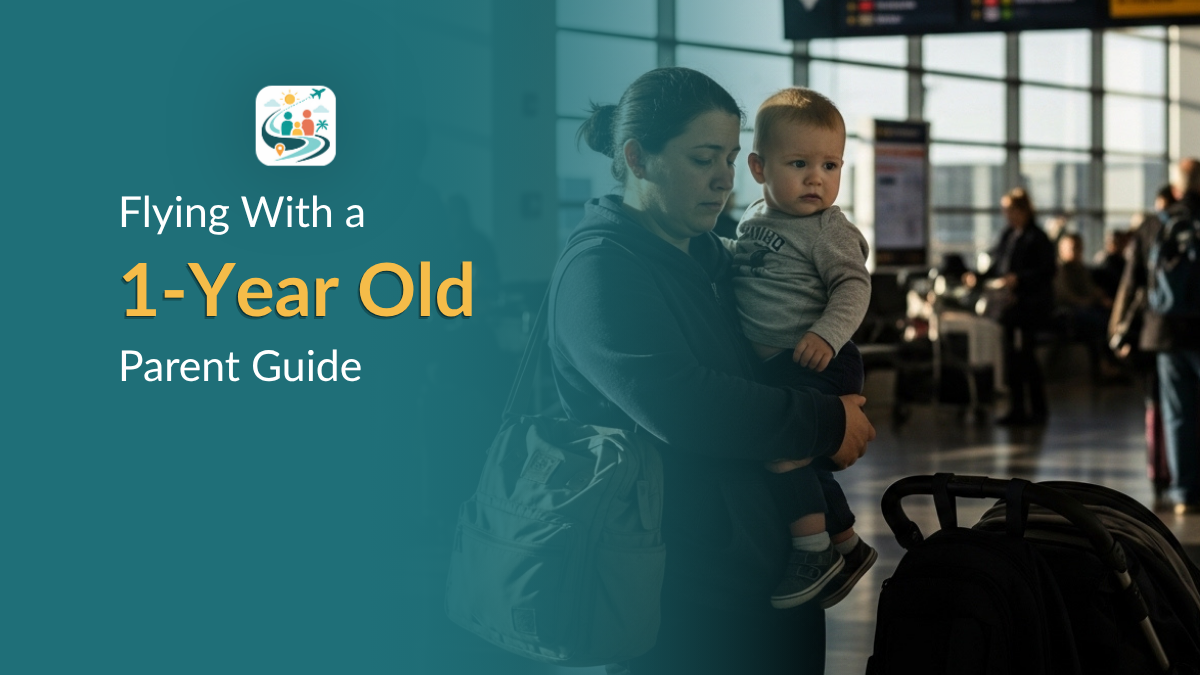
Flying with a 1 year old can feel stressful, especially for first-time parents. At this age, toddlers are active, curious, and easily upset when routines change. Many parents worry about crying on the plane, missed naps, ear pain, and how other passengers might react. There’s also confusion about rules, packing, and whether you’re making the right choices.
The first flight with a 1 year old is often the most intimidating. Every small issue feels like a big problem when you don’t know what to expect. With time, it becomes clear that most challenges are normal and temporary. When parents focus on comfort, preparation, and flexibility, flying with a toddler becomes much more manageable.
General tips
Do your research in advance
Every airline has different rules for lap infants, car seats, and baby gear. Check your airline’s policy before booking. Knowing the rules early prevents stress at the airport. Budget carriers sometimes charge for stroller and car seat checking even when full-service airlines don’t — confirm this specifically before you pack.
Pack with intention

Bring only what you’ll use on the plane. Keep all in-flight essentials in a single bag that fits under the seat in front of you — nothing you’ll need during the flight should go in the overhead bin. A bag you can’t reach is a bag that doesn’t help you.
Bring plenty of distractions
A 1 year old gets bored fast. New or rarely used toys work better than familiar ones because there’s no existing frustration attached to them — a toy your toddler has ignored for a week becomes interesting again mid-flight. Bring more than you think you need and introduce them one at a time.
Get them a seat if possible
Buying a seat gives your child space and lets you use an FAA-approved car seat. It’s also meaningfully safer. The FAA permits lap infants but recommends against it: an unrestrained child cannot be held securely during severe turbulence or a hard stop, regardless of how strong the parent’s grip is. That’s not a remote edge case — it’s the scenario the FAA’s own guidance is written around.
The decision comes down to budget, flight length, and your child’s activity level. For flights under 2 hours on a calm child, the lap infant trade-off is different than for a 6-hour flight with an active toddler.
Board with a plan
Early boarding gives you time to install a car seat and organize the seat area before 150 people are behind you. If your child doesn’t tolerate sitting still, boarding later reduces total seat time. Choose based on your setup — if you’re installing a car seat, board early every time.
Before you fly
Should I book a seat for my 1 year old?
Children under 2 can fly as lap infants. A separate seat is safer and, on longer flights, considerably easier to manage. The rules, costs, and safety tradeoffs are covered in full in our guide to flying with a lap child.
The safest position for a child under 2 is in an FAA-approved car seat secured in its own aircraft seat. This protects them during turbulence and sudden deceleration in ways a lap hold cannot. The FAA permits lap infants but has publicly recommended requiring child restraints — that gap between what’s allowed and what’s recommended is worth understanding before you decide.
If your toddler is approaching their second birthday, the rules change: they’ll need their own ticketed seat, which also changes your car seat and gear strategy. See flying with a 2-year-old for what changes once they age out
What should I do about a car seat when flying?
You can bring an FAA-approved car seat on the plane, but check the seat width against your aircraft before you go. Our guide to car seats on airplanes covers choosing, fitting, and using one. Most narrow-body aircraft (737s, A320s) have seat widths of roughly 17 inches. Many convertible car seats are 17–19 inches wide. Some fit snugly; some don’t fit at all.
See FAA-approved car seats for airplanes for which models qualify and how to check the label. The Cosco Scenera Next is commonly cited as narrow-body friendly at about 16.5 inches wide. Larger Britax and Graco models frequently cause problems on narrow-body aircraft. Check your specific seat’s width before you fly.
If your child is over 22 lbs, the FAA-approved CARES harness is a lighter alternative to a full car seat. It attaches to the aircraft seat back and takes about 60 seconds to install. Worth knowing about if you’re avoiding the bulk of a full seat for a short domestic flight.
Rear-facing installation requires knee room from the seat in front. Forward-facing is usually easier in practice. See how to install a car seat on an airplane for the step-by-step. If the seat doesn’t fit in the first 3 minutes, flag a flight attendant immediately — don’t spend 10 minutes trying to force it while the boarding queue backs up.
What documents does a 1 year old need to fly?
For domestic US flights, most airlines don’t require ID for children. Some ask for proof of age for lap infants — a birth certificate works. For international flights, every traveler including infants needs a passport. See travel documents for infants for the full requirements. Processing time for a first infant passport is currently 6–8 weeks standard, 2–3 weeks expedited.
Can I gate-check my stroller and car seat?
Most full-service airlines allow free gate-checking of strollers and car seats. See our step-by-step guides on gate-checking a stroller and gate-checking a car seat. Get your gate-check tag before you reach the jetway — at the counter or kiosk — so you’re not stuck in line during boarding with a toddler on your hip. Fold the stroller at the jetway door and confirm with the agent that it’ll be returned at the gate on arrival, not at baggage claim.
Can I bring milk through airport security?
Yes. Baby milk, formula, breast milk, and toddler drinks are exempt from the standard liquid limits. Declare them at the screening checkpoint. TSA may swab or test the containers — this is standard and quick. The full TSA rules for breast milk and baby food cover testing and quantities.
What to pack for a 1 year old
Pack diapers, wipes, and 2 changes of clothes (for the child) plus 1 change for you. Bring familiar snacks and a spill-proof cup. Add quiet toys, a few books, and one comfort item for sleep.
A few things packing lists to mention:
Food pouches expand at altitude. Air pressure causes them to swell and spray when opened. Squeeze from the bottom with the cap slightly cracked, not from the top. Bring pouches you’ve opened this way before — mid-flight is a bad time to learn this.
A silicone suction bowl or placemat that sticks to the tray table changes the feeding experience considerably. A 1 year old can’t reach a standard tray table, so you end up hand-holding food for the entire flight without one. A flat silicone bib with a catch pocket also earns its weight.
Snacks that travel badly on planes: anything sticky, crumbly, or requiring two hands to open. Snacks that work: puffs, soft fruit pieces in a sealed container, cheese sticks, crackers that don’t shatter.
Pack everything for the flight into the under-seat bag. If you can’t reach it with one hand while holding a toddler with the other, reorganize before you board.
Our full carry-on packing list for toddlers covers everything else.
At the airport with a 1 year old
Traveling with a toddler is physically demanding. Carrying gear and managing lines gets tiring fast.
If you’re traveling solo, security is the hardest moment. You’ll need to remove shoes, fold the stroller, place items in bins, and walk through the scanner — with no second adult to hand the toddler to. Practice folding the stroller one-handed before you go. Wear slip-on shoes. Put the toddler in a carrier for security so your hands are free for bins and the stroller. See wearing your baby through TSA for how screening works with a carrier.
The overhead bin problem is real when you’re alone: you can’t lift a bag overhead while holding a toddler. Keep everything in your personal item under the seat. If you absolutely have a carry-on, ask a flight attendant or nearby passenger for help — most people will.
Burning off energy before boarding makes a real difference. Find a stretch of terminal corridor and let your toddler walk it. 15 minutes of movement before an hour of sitting helps.
Family restrooms at most major airports have changing tables and more space than standard restrooms. Worth finding on arrival — change the diaper there rather than at the gate or on the plane during boarding.
The first 15 minutes after boarding
What happens in the first 15 minutes after you step on the plane sets up everything that follows.
If you have a car seat to install: put the toddler in the seat first (or in a carrier on your chest), install the seat with both hands, then load bags. Never try to hold the child and install at the same time.
Your personal item goes under the seat in front of you. Nothing you’ll need during the flight goes overhead.
Have one item ready before you board — a specific toy or snack that comes out the moment you sit down. This buys you 5 minutes to get settled before your toddler decides they hate the situation.
Seat the toddler and put their lap belt on before you sort yourself out. The instinct is to get settled first. Do the child first.
If the car seat doesn’t fit within 3 minutes, signal a flight attendant. Don’t force it.
Ear pain: what’s happening and what to do when nothing works
During descent, air pressure drops faster than the middle ear can equalize. Infants’ Eustachian tubes are shorter and more horizontal than adults’ — they equalize more slowly, which is why 1 year olds feel descent more acutely than older children or adults. Our full guide to toddler ear pressure on flights covers prevention and what to try when nothing works
Swallowing opens the Eustachian tube momentarily and helps equalize. Any consistent swallowing motion works: nursing, a bottle, a pacifier, a snack. Start before descent begins — about 10–15 minutes before expected landing — rather than waiting until your child is already in pain. Once a toddler is crying hard, swallowing gets interrupted and the technique stops working.
When standard tactics fail:
- Try gentle jaw movement: open and close the child’s mouth manually
- Change position: sometimes upright vs. reclined makes a difference
- If nothing helps during descent, it ends when the plane levels out — pressure equalizes at ground level
If your toddler cries persistently for more than an hour after landing, fluid or a minor ear injury is possible. A pediatrician check is appropriate.
Decongestants and antihistamines are not recommended for children under 2 for this purpose. They don’t address the Eustachian tube mechanism and carry cardiac risks in infants. This applies even to infant-labeled products.
If your toddler has had ear infections or fluid in the past 2 months, ask your pediatrician before flying. Recent ear infections can make equalization harder and more painful.
How to entertain a 1 year old on a plane
Sleep: Fly after a nap when you can — a rested toddler boards curious rather than exhausted. “Match nap time” advice breaks down if your toddler is currently in a nap transition (common between 12–18 months and again around 2.5–3 years). If nap timing is unpredictable, plan around distraction rather than sleep.
Snacks: Offer them slowly, one at a time, spread across the flight. Front-loading all the snacks in the first 30 minutes leaves you nothing for the last hour.
Toys: Introduce new ones one at a time. A toy that’s been in the bag for 20 minutes feels newer than one that’s been in their hands since the gate. Rotate through rather than dumping everything out at once.
Electronics: Short videos work well during turbulence or the last stretch of a long flight when everything else has run out. Download content before you fly — in-flight WiFi is unreliable for streaming.
Singing: Soft, familiar songs work for younger 1 year olds (12–15 months) more than for older ones. By 18–20 months, most toddlers are more interested in visuals and objects than in listening.
Everyday items: The airline’s safety card, a plastic cup, the window shade — these hold attention longer than purpose-built toys for some children. Don’t underestimate what’s already around you.
Change positions: Stand up and hold them facing the aisle, switch laps, sit them facing you. Position changes reset attention spans for a few minutes each time.
When your toddler cries and nothing works
Some flights go wrong despite everything. Here’s what’s actually useful to know.
A toddler who is fully dysregulated — past the point where distraction works — usually doesn’t need more stimulation. More toys, louder singing, more snacks can make it worse. The more effective response is calm physical containment: chest-to-chest hold, reduced noise, lowered activity from the parent. This feels counterintuitive but it works more often than escalating.
A full cry episode in a 1 year old typically peaks within 10–15 minutes and resolves. See managing toddler tantrums on a plane for more on de-escalation. That’s not a short time when you’re in it, but knowing it has a natural arc is useful.
During descent specifically: sustained crying that starts at the beginning of descent and doesn’t respond to any distraction is often ear pain, not general distress. The distinction matters because the response is different — feeding and jaw movement, not toys and singing.
What other passengers hear is less than what parents imagine. Aircraft cabin noise runs around 80 decibels — a toddler crying adds to that, but it’s not the isolating experience parents fear. Most passengers have noise-canceling headphones. Most have been on a flight with a crying child before.
Walk the aisle if it’s allowed. Some toddlers reset with movement. Ask a flight attendant whether the galley area is available — standing and swaying there for 5 minutes sometimes works when the seat doesn’t.
Flying solo with a 1 year old
Standard toddler flight advice assumes two adults. If you’re flying alone with a 1 year old, several tips don’t apply and a few specific problems need a different approach. Our full guide to flying solo with a baby or toddler covers the logistics end to end.
The bathroom problem: you can’t leave a 1 year old in a seat alone. Options: bring them into the lavatory with you (cramped but works), ask a flight attendant to watch them briefly at the galley, or time bathroom use during sleep. The lavatory option is the most reliable.
Boarding sequence alone: personal item under the seat first, car seat installed second (toddler in carrier during this), toddler into seat third, overhead bag last (or skip the overhead bag entirely). Don’t try to do these out of order.
Connecting flights: 55 minutes is the minimum most airlines publish. With a gate-checked stroller, a car seat to retrieve at the jetway, a toddler who can’t walk at adult speed, and an unfamiliar terminal, 55 minutes is tight. 75–90 minutes is realistic. If your only option has a short connection, know the gate-check process for your specific carrier — some airlines return gate-checked items at the door, others require you to wait at the end of the jetway.
In-flight meal service: you won’t have a free hand. Eat before you board if you need to eat. Pack your own food in the under-seat bag at easy reach.
How this changes as your 1 year old gets older
“1 year old” covers a lot of ground developmentally. A 12-month-old who isn’t yet walking is a different travel companion than a 22-month-old with strong opinions and fast legs.
12–15 months: pre-walking or early walking, still highly containable, nursing or a bottle is usually the most reliable comfort tool. Attention spans are short. Simple sensory toys (crinkle textures, peek-a-boo) hold attention longer than videos.
15–18 months: walking is established and sitting still is harder. Object permanence is solid — hiding a toy and “revealing” it works once, then they expect it. Language is minimal, so reasoning doesn’t work yet. Distraction over engagement.
18–21 months: strong preferences and refusals are emerging. “No” appears as a primary communication. Screen time becomes more reliably effective. Brief, familiar videos hold attention in a way that books and toys don’t consistently match.
21–24 months: some limited reasoning starts to work (“after the snack, we’ll watch a video”). Tantrums can peak in this period. The lap infant seat question becomes financially urgent as the second birthday approaches — if you’re flying close to the birthday, check your airline’s policy on the cutoff date for lap infant fares.
Ear pain management also shifts: younger infants need nursing or a bottle because they can’t follow the instruction to “swallow.” By 20–22 months, you can prompt them to chew or drink on command, which gives you more options during descent.
Tips for you (the parent)
Dress in layers and clothes you can move in easily.
Bring noise-canceling headphones and a backup pair — earbuds at minimum. Not for comfort on the flight, but for the minutes when you put the toddler down and need 90 seconds of quiet.
The SkyClip holds a phone or tablet on the tray table at toddler eye level, freeing both your hands. Worth the $15 for flights over 2 hours.
Take a photo of your toddler at the gate. Not for memories — for identification if they wander in a crowded airport.
Jet lag
Jet lag hits toddlers faster than adults because their sleep is lighter and more frequent. On arrival, use natural daylight to reset the clock: outside time in the morning at the destination, dimmer indoor light in the evening. Keep meals and nap timing as close to the destination schedule as possible from day one. Don’t let them sleep past their normal wake time in the destination time zone, even on day one.
Give it 2–3 days. Most 1 year olds adjust faster than adults.
Frequently asked questions
Flying is generally safe. The specific risk worth understanding is the lap infant question: lap infants are permitted but are the only unrestrained passengers on the plane. For short domestic flights in calm conditions, many families make this trade-off. For longer flights or with an active toddler, a separate seat with an approved car seat is the safer choice. The FAA’s own recommendation is to use a child restraint system.
Recommended when budget allows, especially for flights over 2 hours. A separate seat is safer and makes naps considerably easier. For short flights on a tight budget, a lap infant is manageable — many families do it without incident. Know what you’re trading off.
Yes, but it’s physically demanding. Your arms and back will tire. On flights over 90 minutes, the physical strain on the parent is a real factor — plan for it.
Yes. Baby milk, formula, and breast milk are exempt from liquid limits. Declare them at the checkpoint. TSA may swab the containers — this is routine.
If you’ve tried feeding, position changes, toys, walking, and singing, and nothing is working, lower the stimulation rather than increasing it. Calm, quiet chest-to-chest holding often works better than escalating distractions. If the crying starts specifically at descent and doesn’t respond to anything, ear pain is the likely cause — try gentle jaw movement and feeding. It resolves at ground level when pressure equalizes.
Conclusion
Flying with a 1 year old doesn’t require a perfect trip. It requires understanding your child, packing what you’ll actually use, and staying calm when the plan changes. Crying, missed naps, and delayed flights are normal. They don’t mean you’re doing anything wrong.
Each flight gets easier. The first one is the hardest.