


Most parents don’t worry about lap child rules until they’re mid-booking and suddenly not sure if they’ve done it right. What is the minimum age? What if someone asks for proof of age? What happens during turbulence? Airline pages list policies but don’t explain them. This guide answers those specific questions in plain language. For everything else about the trip, see our complete guide to flying with a baby or toddler.
Key takeaways: flying with a lap child
- A lap child is a child under 2 years old who sits on an adult’s lap
- Most U.S. domestic flights allow lap children for free, but you must add the child to your booking
- International flights often charge taxes and fees — typically around 10% of the adult fare, though the real dollar amount varies widely by route
- One adult can travel with only one lap child
- Exit rows are off-limits for lap children; some bulkheads are restricted too
- Buying a seat is safer; many families choose lap travel to manage costs
What is a lap child?
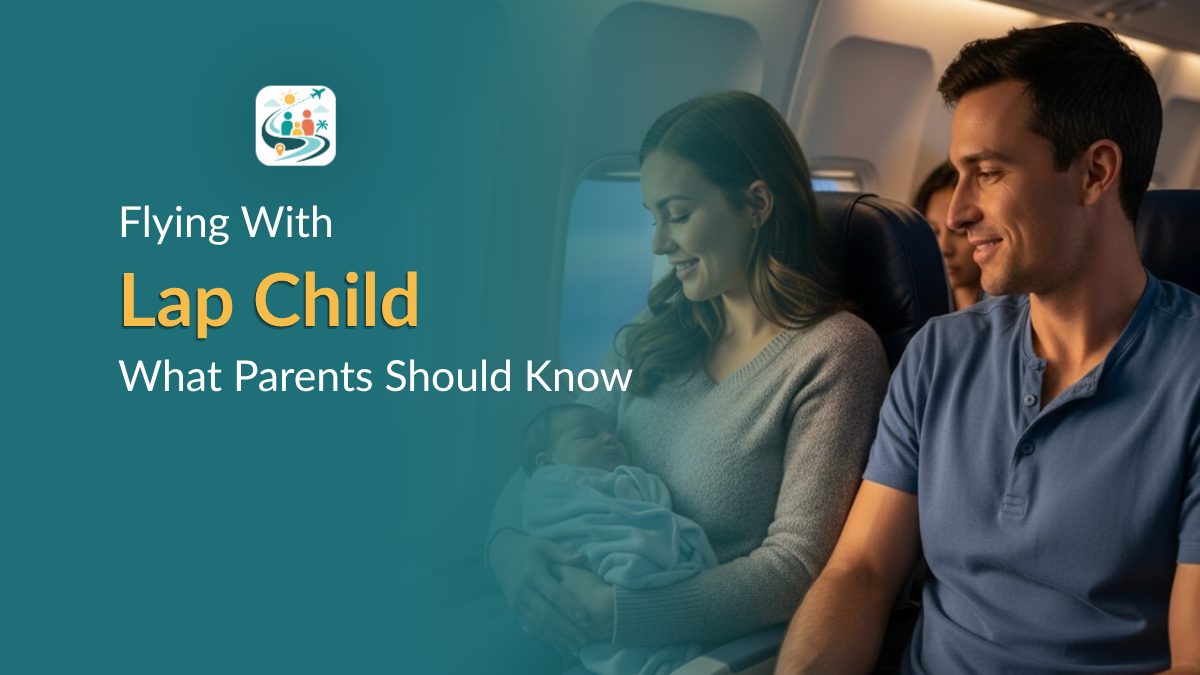
A lap child is a baby or toddler under 2 years old who doesn’t have their own airplane seat. The child sits on an adult’s lap for the flight. Airlines also call this “infant-in-arms.”
Once your child turns 2, they need their own seat.
The age rule: under 2 on the day of travel
Airlines follow this rule strictly. Your child must be under 2 on the departure date, not the booking date.
If your child turns 2 during a multi-leg trip, the rules change mid-journey. You may need to buy a seat for the return flight. See flying with a 2-year-old for what changes once they need their own seat. This catches many parents off guard. If your child’s second birthday falls anywhere near the travel window, check each leg separately and call the airline to confirm what’s required.
Is flying with a lap child free?
For domestic U.S. flights, yes — in most cases. You still have to add the child to your booking, but there’s no fare charge.
International flights are a different story. Most airlines charge taxes and fees, often calculated as roughly 10% of the adult fare. On a $400 economy round-trip, that’s about $40. On a $1,800 business class fare, it’s $180. Some carriers use flat fees instead, which can run anywhere from $25 to over $100 depending on the route. Check the specific charge before booking — it’s not always visible until checkout, and it’s worth a call to confirm.
How to add a lap child to your booking
Some airlines let you add a lap child during the online booking flow. Others require a phone call. If you booked through a third-party site — Expedia, Google Flights, Kayak — almost none of them support lap child additions. You’ll need to call the airline directly after booking.
The process that works:
- Complete your ticket purchase first
- Add the lap child during booking if the option appears
- Call the airline if it doesn’t appear — don’t leave it for the airport
After the call, ask the airline to email you a confirmation that the lap child is in the booking. Screenshot it. If there’s a dispute at check-in, this is what resolves it.
One more thing to check: if your outbound and return flights are booked as separate tickets, the lap child must be added to each one independently. It doesn’t carry over automatically.
Flying with a lap child on miles or award tickets
Lap child rules apply the same way on award tickets. International taxes still apply and must be paid even on a free award flight. In most cases, the airline creates a separate ticket number for the child — you’ll want to confirm this happened when you call.
Award bookings take longer to fix when something goes wrong. Call as early as possible to add the child. Don’t leave it until the week before departure.
Codeshare flights and lap children
If you’re flying a codeshare — booked on Airline A but physically operated by Airline B — the operating carrier’s lap child rules apply, not the marketing carrier’s. This matters because policies on seat restrictions, fees, and documentation requirements can differ between carriers.
Before the flight, confirm that both airlines have the lap child in their system. The booking confirmation from one carrier doesn’t automatically update the other. A quick call to the operating carrier a few days before departure is worth the time.
Empty seats and lap children
Some parents hope an empty seat next to them will free up space for the child. It happens, but it’s never guaranteed on a full flight. Plan to hold your child the entire flight. If a seat opens up and the crew offers it, treat it as a bonus.
Luggage rules for lap children
Lap children don’t get a full baggage allowance, but most airlines do allow:
- 1 diaper bag (often treated as a personal item)
- 1 stroller or car seat checked for free
Rules vary by carrier. Check before you pack, especially on budget airlines where baggage policies are stricter. See how to gate-check a stroller so you keep it right up to the plane door.
Traveling with more than one lap child
One adult can hold one lap child. That’s it.
If you’re flying with twins or two children under 2 without another adult, you’ll need to buy a seat for one of them. This is one of the more common planning mistakes families make, and fixing it last-minute is expensive. Sort this out before booking.
Where lap children can’t sit
Lap children aren’t allowed in emergency exit rows. Some bulkhead seats are also restricted, depending on the carrier and aircraft type. These are firm rules, not gate agent discretion.
If you’re automatically assigned an exit row at check-in — which happens occasionally when the booking system doesn’t flag the lap child correctly — ask to be moved immediately. Don’t wait until boarding.
Safety: what the FAA says and what it means
The FAA’s position is clear and worth understanding directly: they recommend against lap child travel and have for decades. The reason is physics. In severe turbulence or a sudden stop, the forces involved can exceed what any adult can hold against. “Difficult to hold securely” understates it — in a rapid deceleration event, no grip is strong enough.
The FAA has stopped short of banning lap children because their own modeling showed that mandatory car seats would price some families off planes and onto roads, where the per-mile fatality rate for young children is higher. So the policy allows it; the safety recommendation doesn’t endorse it.
What this means in practice: lap child travel on a calm, short domestic flight carries very low absolute risk. Severe turbulence is uncommon, and air travel is extremely safe. But the risk is real, not imagined, and parents deserve to know what they’re choosing rather than receiving a generic hedge.
Buying a seat and using an FAA-approved car seat is the safest option. A child in a properly installed restraint system is protected during the forces that precede and include most in-flight incidents. A child on a lap is not. Our guide to car seats on airplanes covers choosing, installing, and flying with one.
Should you buy a seat for your child under 2?
A few specific scenarios where buying a seat is worth the cost:
- Flights over 3 hours, where holding a child for the full duration is genuinely exhausting
- Active toddlers approaching 2, who are difficult to contain on a lap
- Red-eye flights where you want the child to sleep in a car seat rather than on you. Our guide to red-eye flights with toddlers covers when the overnight option is worth it.
- Any flight where your safety concern is high enough that you’d spend the trip anxious about it
- If your child is over 22 pounds, the CARES harness is a lighter FAA-approved alternative to a full car seat.
Babywearing on a plane
If you plan to use a carrier or wrap, know the rules before you board.
The FAA requires that babies be held in arms — not in a carrier — during taxi, takeoff, landing, and any time the seatbelt sign is on. The reason: in an impact event, a carrier can compress against a baby’s airway, and the parent’s body becomes a force multiplier onto the child.
During cruising with the seatbelt sign off, carriers are allowed. You can use them freely between the restricted phases.
Gate agents sometimes instruct parents to remove babies from carriers before boarding. This is not an FAA rule and not most airlines’ official policy. Screening has its own rules — see wearing your baby through TSA. Carriers are allowed in the cabin. If this happens, you can politely clarify.
For practical purposes: a stretchy wrap is the easiest to remove and re-don at the gate. Structured carriers work well during cruise but take longer to get on and off during the phases when you need the baby in arms. Have a plan for where the carrier goes during takeoff and landing — your lap, the overhead bin, or a bag — before you’re asked to stow it.
Nursing and feeding while flying
Having the baby on your lap does make nursing more accessible, especially during takeoff and landing. Feeding or nursing during descent helps with ear pressure equalization — swallowing is one of the most effective ways a baby can clear their ears.
The limitation is space. Plane seats don’t give you much room to adjust position, and fixed armrests on bulkhead seats can make latching uncomfortable. On longer flights, the positioning gets tiring before the baby does.
If nursing privacy matters to you, an aisle seat gives you more options than a window. Bring a cover or light blanket if you want one — there’s no guarantee the seat next to you will be empty.
Bulkhead seats: when they help and when they don’t
Airlines often assign lap child families to bulkhead rows because that’s where bassinets are located. On longer flights, a bassinet can make a real difference — but only if your child still fits.
Most airline bassinets have a weight limit of 20–25 lbs and a length limit of roughly 70 cm. Many toddlers approaching age 2 have already outgrown them. Check the specific dimensions for your carrier and aircraft before counting on it.
The downsides of bulkhead seats that most parents don’t know about until they’re sitting in them:
- No under-seat storage. Everything goes in the overhead bin, which is inaccessible during boarding, taxi, takeoff, and landing. Any supplies you need for those phases have to fit in your lap.
- Fixed armrests that don’t fold up. This makes nursing and repositioning the child harder, not easier.
- Tray tables inside the armrest. Less convenient with a child on your lap.
For short flights where overhead bin access matters throughout, a non-bulkhead aisle seat is usually more practical. For long-haul flights with a baby who still fits in a bassinet, request the bulkhead early — availability is limited and first-come.
Proof of age and required documents

Airlines may ask for proof that your child is under 2. This doesn’t happen at every check-in, but it does happen — especially at the gate when a toddler looks older than their age.
Accepted documents:
- Birth certificate (copy is fine for domestic; original or certified copy preferred for international)
- Passport (required for international travel regardless)
Carry both if you have them. A birth certificate alone covers domestic travel. International trips require a passport — babies and toddlers need their own, regardless of age, and the processing time for a first infant passport is currently running 6–8 weeks through standard service.
Before you fly: quick checklist
Tips for flying with a lap child
- Book flights close to your child’s nap time if your schedule allows it
- Change the diaper as close to boarding as possible — not 45 minutes before
- Keep one small new toy or snack in your personal item specifically for the flight, separate from the rest of the bag
- If you’re at the gate and your seat assignment is in an exit row, fix it before boarding — not during
Minimum age to fly
Most airlines allow newborns to fly as early as 2–14 days old, but policies vary. If your baby was premature or has any respiratory or cardiac concerns, talk to your pediatrician before booking. Some airlines require a medical clearance letter for very young infants.
Frequently asked questions
Lap child travel is legal and extremely common. The FAA recommends against it and endorses car seats in purchased seats as the safest option. On a calm short-haul flight, the absolute risk is low. On longer flights or with an active toddler, the physical and safety case for buying a seat is stronger.
Yes. Most airlines issue one, even though no seat is assigned. This is how the child is logged in the airline’s system. Confirm you have one before leaving the check-in counter.
No. A car seat can only be used in a purchased airplane seat. It cannot be used on your lap.
No. One adult can hold one lap child. If you’re traveling with two children under 2 without another adult, one child needs a purchased seat.
You’re likely fine on the outbound flight if they were under 2 on that departure date. For the return, you may need to purchase a seat. Call the airline before you travel — don’t wait until you’re at the airport on the return day.
Bottom line
Lap child travel is manageable when the rules are clear in advance. The two areas that cause the most last-minute stress are booking problems — not adding the child to the reservation correctly, or missing the codeshare complication — and the age cutoff when a child is close to turning 2.
The safety question deserves a direct answer: lap travel is allowed, but the FAA’s own guidance says a car seat in a purchased seat is safer. For short domestic flights, most families accept that trade-off. For longer flights, the cost of a seat becomes easier to justify.
Plan the booking carefully, carry proof of age, and know the rules for your specific carrier before you get to the airport. The flight itself is usually the easiest part.