




I still remember when my husband and I attempted our first flight with our daughter, a diaper bag the size of a small suitcase, and a stroller I genuinely had no idea how to fold under pressure. One of the biggest stress points parents face is not knowing what will happen to their stroller at TSA: will security take it away, will you slow down the line while folding it, or will officers ask you to unpack everything in front of other travelers? These fears are real, and almost every traveling parent experiences them before their first flight.
The stroller security checkpoint is usually the moment parents feel the most pressure. The first time I traveled with a stroller, I worried about holding up the line and not understanding TSA instructions. After learning the process and preparing ahead of time, I realized stroller screening is simple and quick once you know what to expect. This guide explains exactly how TSA handles strollers, step by step, so you can avoid the common mistakes that cause delays or stress.
Yes, you can take a stroller through airport security
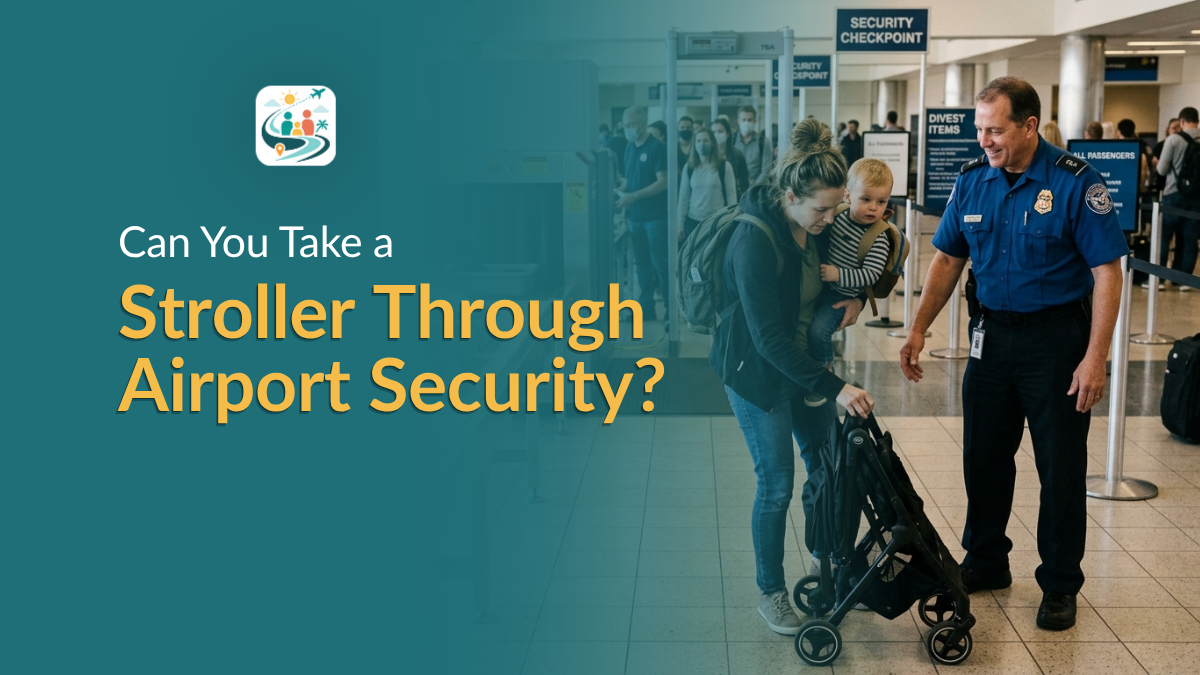
The Transportation Security Administration (TSA) allows strollers at airport security checkpoints. Parents can usually use their stroller throughout the airport right up until boarding time.
TSA must screen every stroller before it enters the secure boarding area. If your stroller fits inside the X-ray scanner, officers will place it on the screening belt. If it’s too large, they’ll perform a manual inspection instead. Parents must also remove their child from the stroller before screening begins — something that caught me off guard the first time, since I assumed she could just stay buckled in while we rolled through.
Step-by-step guide: taking your stroller through TSA security
Once you’ve done it a time or two, it genuinely becomes second nature.
Step 1: Prepare before entering the security line
Before joining the line, remove loose items from your stroller basket. TSA requires these to go into screening bins separately.
Common items to remove:
- Toys
- Snacks
- Blankets
- Portable fans
- Cup holders and phone mounts
- Storage bags and hanging organizers
Keep baby liquids and medications easy to access in a dedicated pouch at the top of your diaper bag — not at the bottom. You may need to present them separately, and digging through everything at the belt slows you down and the people behind you.
One thing most articles skip: strip the stroller of accessories before you reach the belt, not at it. Removing a rain cover, footmuff, or clip-on toy tray at the checkpoint while a line grows behind you is avoidable stress. Do it while you’re waiting in line.
Step 2: Remove your child from the stroller
TSA requires parents to remove children from strollers before screening. You’ll carry your baby through the metal detector. If you’re using a baby carrier, TSA usually allows it, but officers may request removal for additional screening. Wear something you can unbuckle quickly.
Step 3: Fold the stroller for screening
Most strollers must be folded before going through the X-ray machine. Practice the fold at home before your trip — but practice specifically with one hand occupied. If you’re holding a baby, you have one hand for the fold. Many strollers that seem simple at home require two hands and a knee simultaneously. Find out now, not at the checkpoint.
Umbrella and compact travel strollers typically fit inside the X-ray machine when folded. The fold mechanism also behaves differently in cold terminal air than at room temperature, so if you’re traveling in winter, factor that in.
Step 4: Manual screening for larger strollers
Full-size, jogging, and double strollers usually require manual inspection. Officers may swab the stroller with an explosive trace detection (ETD) wand.
What that swab is actually testing for: residue from certain chemicals, including fertilizers, some medications, and gunpowder. Most parents go through without any issue. If the swab does flag, an officer will conduct secondary screening — expect 5 to 15 additional minutes. You’ll be asked to step aside. Have a plan for who holds the baby while the stroller is being inspected, especially if you’re traveling alone.
Step 5: Reassemble your stroller after screening
After screening, move away from the belt immediately, even if you’re only partly reassembled. Most airports have a repacking area near the checkpoint exit. Use it. Stopping at the belt to repack blocks the flow for everyone behind you and adds to your own stress.
Stroller security checklist before TSA
- Strip accessories before joining the line: cups, fans, organizers, rain covers, hanging toys
- Pack baby liquids and medications in a top-access pouch
- Practice the one-handed fold at home before travel day
- Know whether your stroller needs X-ray or manual inspection (see table below)
- Have your child ready to be carried or held during screening
- Arrive with 30 extra minutes if your stroller requires manual inspection
Do all stroller types go through security the same way?
No. The experience varies significantly by stroller type.
These are estimates for off-peak hours. During peak travel periods — Friday afternoons, Sunday mornings, holiday travel — add another 5 to 10 minutes.
What happens if your stroller can’t fold?
Officers perform a manual inspection by hand. For non-folding strollers or very large wagons, you may be asked to step aside while they check it. Some airlines suggest checking an extremely large stroller before security rather than at the gate — worth confirming with your airline before travel day.
Wagons are their own category. Foldable wagons can sometimes pass through screening, but not all TSA officers have a clear protocol for them. If you’re traveling with a wagon, call TSA ahead of time (1-866-289-9673) to understand what to expect at your specific airport.
Can you use TSA PreCheck with a stroller?
Yes, if you’re eligible, PreCheck speeds up the experience around the stroller screening. Shoes stay on, laptops stay in the bag, shorter lines.
The stroller still gets screened regardless of PreCheck status. PreCheck doesn’t change the stroller process itself — it just removes friction from everything else.
Can you wear your baby through TSA security?
Yes, and I found it considerably easier than juggling a stroller and a toddler simultaneously. TSA usually allows baby carriers through the metal detector. Officers may ask you to remove the carrier for additional screening, so wear something you can unbuckle quickly with one hand.
What baby items can go through airport security?
TSA allows baby liquids beyond the standard 3.4 oz limit, including:
- Breast milk
- Formula
- Baby food
- Infant juice
Declare these items before screening begins. Keep them in a separate, easily accessible bag — not mixed in with your other liquids. Some officers will ask you to remove them for inspection; some won’t. Being prepared either way takes about 10 seconds.
Should you check your stroller or bring it through security?
The right answer depends on your airport, your flight, and your child.
Bring it through security if: your airport has long walks between gates, your child needs the stroller to manage a layover, or you want it accessible during a long wait at the gate.
Check it at the ticket counter if: you’re at a small regional airport with short gate distances, your child is comfortable in a carrier for the full airport stretch, or your stroller is large enough that manual inspection would eat into your buffer time.
Gate-check it if you want the stroller available through the terminal but don’t mind collecting it at the jet bridge on arrival. One thing to know: on regional aircraft (small planes), gate-checked strollers sometimes go into the hold rather than the jet bridge, which means you retrieve it at baggage claim rather than at the door. Ask the gate agent specifically where it will come off before you hand it over.
Stroller damage during gate-checking is more common than during security screening. If you gate-check a stroller you care about, use a gate-check bag and photograph the stroller before you hand it over. If it comes back damaged, report it before leaving the airport — most airlines require you to report damage before you exit the baggage claim area.
TSA Cares: extra help for families
TSA Cares (1-855-787-2227) is a support program for travelers who need assistance at the checkpoint, including families with multiple young children, children with special needs, or parents who are anxious about navigating security alone. Call or fill out the online request form at least 72 hours before your flight. A passenger support specialist will meet you at the checkpoint.
This is genuinely useful and underused. If you’re traveling solo with two children, or your child has a sensory sensitivity that makes the checkpoint environment difficult, TSA Cares is worth the 5-minute call.
How long does stroller screening take?
Compact, foldable strollers going through the X-ray belt: 2 to 3 extra minutes. Large strollers requiring manual inspection: 5 to 10 minutes off-peak, up to 20 minutes during busy travel periods.
Build your airport buffer around which category you’re in. If your stroller needs manual inspection, arrive 30 minutes earlier than you normally would.
Common TSA mistakes parents make
- Leaving accessories on the stroller until they’re at the belt, then scrambling to remove them
- Not knowing the fold until they’re under pressure with a line behind them
- Packing baby liquids at the bottom of the diaper bag
- Not having a plan for who holds the baby during manual inspection
- Stopping at the belt to repack instead of moving to the repacking area
Most of these have the same fix: do the preparation before you join the security line, not when you reach the front of it.
International security differences
International airports operate under different authorities with different rules, and the differences are specific enough to matter.
UK airports (Heathrow, Gatwick): the baby liquid exemption exists but officers sometimes apply the 100ml rule inconsistently for formula and expressed milk. Carry documentation from your pediatrician if you’re traveling with a large quantity of formula.
EU airports: the 100ml liquid rule technically applies to baby liquids, but most EU airports make exceptions for formula and breast milk in reasonable quantities for the journey. Check the specific airport authority’s website before you travel.
Canadian airports (CATSA): procedures closely mirror TSA. NEXUS (the Canadian equivalent of TSA PreCheck and Global Entry combined) gives you access to expedited lanes. Strollers still require screening.
Mexican resort airports (Cancún, Los Cabos): security at these airports is often military-operated rather than civilian. Stroller screening is typically faster and less formal than TSA, but procedures can vary by shift. Baby liquids are rarely questioned.
Re-entering the US after international travel: customs and border protection adds a step. You’ll retrieve checked luggage, clear customs, re-check bags, and go through security again if you have a connecting domestic flight. Factor in the stroller process for that second screening as well.
Frequently asked questions
No. TSA requires every child to be removed from the stroller before it goes through screening. Carry your baby or use a baby carrier while the stroller is checked separately.
In most cases, yes. Compact umbrella and travel strollers fold and go through the X-ray machine. Full-size and jogging strollers usually can’t fit, so they get a manual inspection without needing to fold. If you’re unsure, practice the fold at home with one hand occupied.
Security screening rarely damages strollers. The higher damage risk is gate-checking. If your stroller is expensive, use a gate-check bag and photograph it before handing it over. Report any damage before leaving the baggage claim area.
Foldable wagons can sometimes go through just like a stroller. Non-foldable wagons require manual inspection, and officer protocols vary. Call TSA at 1-866-289-9673 before your trip if you’re traveling with a wagon, so you know what to expect at your specific airport.
Final thoughts
Stroller screening is one of the more manageable parts of flying with kids once you know the process. The steps don’t change, the rules are consistent, and most of the stress is front-loaded: it’s highest the first time, and drops quickly with experience.
Strip the stroller before you join the line. Know your fold. Have a plan for the baby during inspection. Everything else follows from those 3 things.


