


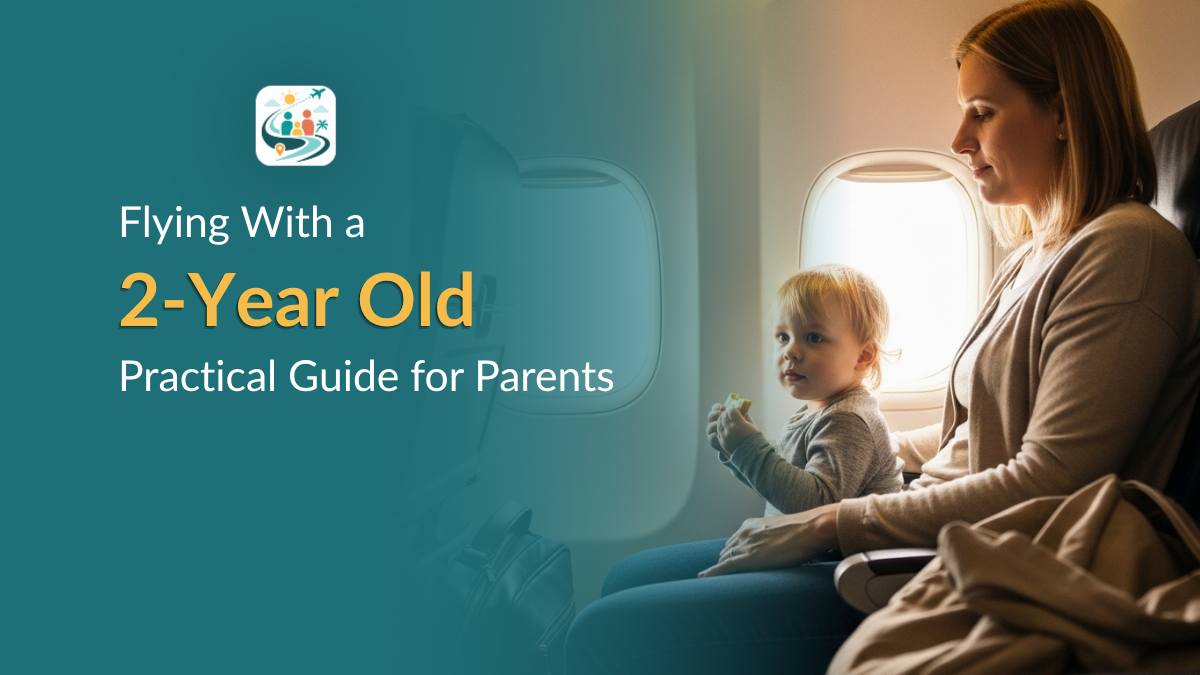
Flying with a 2-year-old feels harder before the trip than during it, for most parents. At this age your toddler wants independence and has no idea what airplane rules are. You’re picturing tantrums, crying, and stares from other passengers. You’re also unsure about seats, packing, and how to keep a toddler still in a tight space.
On our flight from Denver to Orlando last spring, I checked the snack bag three times at the gate and still second-guessed the car seat decision.
This guide comes from that kind of trip, plus research into current airline policy and what other parents actually run into. It’s built to make the next flight less stressful, not perfect.
Quick takeaways: flying with a 2-year-old
- A 2-year-old almost always needs their own paid seat. A few international carriers and specific fare programs handle this differently, so confirm before you book.
- A car seat is optional. It helps with containment and sleep, but costs you carry weight and install time.
- If you bring a car seat, it goes in the window seat. That’s a safety rule, not a preference.
- Snacks and a short activity rotation prevent most meltdowns. Not all of them.
- Toddler emotions on a flight are normal. Safety is the goal here.
Managing your own pre-flight anxiety
The days before a flight are often harder than the flight itself. A lot of parents notice this: the anticipation builds for days, then eases once you’re actually in your seat and moving.
Some of that anxiety isn’t really about the toddler. It’s the ordinary fear of flying underneath it: turbulence, the small chance something goes wrong, or being sealed in a cabin for hours with no way to step outside. Knowing the statistics doesn’t always make that fear go away, and that’s normal.
If pre-flight anxiety is a pattern for you regardless of who you’re traveling with, it’s worth working through on its own, separate from the toddler-specific prep in this guide.
Before you fly
Good preparation reduces stress on travel day. Small choices matter more than people expect.
Do you need a car seat for a 2-year-old on a plane?
Most US airlines require a seat and ticket once a child turns two. Some international carriers and certain fare or loyalty programs handle this differently, so check with your airline before booking, especially on international routes or when a birthday falls between your outbound and return flights.
A car seat on the plane is optional. Some parents bring one because their toddler is used to it, sleeps better in it, or stays seated more reliably with the familiar restraint. Others skip it to travel lighter and move through boarding faster.
Both are normal choices. The right one depends on your toddler’s temperament, the flight length, and how much gear you’re already carrying.
Car seat vs. plane seat: quick decision chart
| Option | Best for | Things to know |
| Bring a car seat | Sleepy toddlers, toddlers who wiggle a lot | Adds weight to carry, but gives a familiar, contained seat |
| Use the airplane seat only | Short flights, light packing | Needs more hands-on redirection during the flight |
| Hold as a lap child | Rarely an option at age 2 | Most airlines require a ticket and seat after age 2 |
Best seat for a toddler with a car seat
If you’re bringing a car seat, plan on the window seat. Airlines treat this as a safety and evacuation requirement, not a preference, so request it when you book.
Skip the bulkhead if you can. The extra legroom sounds appealing, but bulkhead rows don’t have storage under the seat in front of you. Everything goes in the overhead bin, which means climbing up to dig through it every time your toddler needs something.
The back of the plane works well for a lot of parents. It puts you closer to the restroom, and it means fewer people notice if your toddler gets loud or wants to stand in the aisle.
Tips for flying with a car seat
If you decide to bring one, keep it simple.
- Check that it’s certified for airplane use.
- Install it in a window seat.
- Practice the installation before your trip, not at the gate.
- Use a strap or travel cart to move it through the airport.
Installing the car seat is your job, not the flight attendant’s. Don’t expect help clipping it in.
Check that your car seat has FAA approval before you fly. That’s what confirms it’s built to fit an airplane seat, not just a car.
A car seat can help with behavior, not just safety. Toddlers used to being buckled in for travel tend to associate the seat with staying put.
What do you need to fly with a 2-year-old
Focus on comfort, food, and cleanup.
Essentials:
- Diapers or pull-ups
- Wipes
- 2 to 3 extra outfits
- Snacks for the full flight, plus a buffer
- A comfort item: a blanket or one favorite toy
Keep all of this in your carry-on. If it ends up in checked luggage, you won’t get it back mid-flight.
Can I hold my toddler on the plane?
Most airlines stop allowing lap seating once a child turns two. Your toddler will need a paid seat.
Even where lap seating is technically allowed, holding a toddler for a full flight wears you out fast. A seat gives them room to eat, move, and settle. If your toddler just turned two, the rules from your last flight with them don’t apply anymore.
What are the airline’s policies on checking baby gear?
Most airlines let you check a stroller and car seat at no extra cost. Gate-checking the stroller is often easier than checking it at the counter, since you keep it with you through the airport.
Gate-checked gear does get handled roughly sometimes. Wheels bend, canopies tear. If yours comes back damaged, go to baggage services before you leave the airport, not after you get home. Confirm your airline’s specific policy before flying, since it varies by carrier.
Can I bring snacks, milk, or juice through airport security?
Yes. Solid snacks go through without issue: crackers, dry cereal, fruit, snack bars.
Milk and juice usually go through too. TSA may test or inspect them, so keep liquids somewhere you can reach quickly instead of buried in a bag.
What should I pack for a 2-year-old
A simple checklist beats overpacking.
Carry-on packing checklist for a 2-year-old
| Category | What to pack |
| Essentials | Diapers or pull-ups, wipes, hand sanitizer, tissues |
| Clothes | 2 to 3 outfit changes, light jacket, extra socks |
| Food & drinks | Snacks for the whole trip, refillable cup, spill-proof snack container |
| Comfort | Small blanket, favorite toy, pacifier if used |
| Entertainment | Stickers, books, small toys, tablet with downloads, toddler headphones |
| Clean-up | Plastic bags, extra wipes, bib, small towel |
If your toddler is potty training, bring pull-ups and extra clothes. Plane bathrooms are small and hard to use quickly.
At the airport with a two-year-old
Airports overwhelm toddlers. They’re loud, bright, and full of things to touch.
Arrive early enough that you’re not rushing. Let your toddler walk and explore where it’s safe to. Movement before boarding buys you sitting time once you’re on the plane.
Early boarding isn’t automatically the right move. If you’re installing a car seat, take the extra boarding time. If you aren’t, boarding last can mean less time in a cramped seat before the flight even starts.
What actually goes wrong at the airport
Three things come up again and again for parents flying with young kids.
Losing track of documents. The passport-in-the-diaper-bag panic is common enough that it’s worth designating one pocket, every trip, for passports and boarding passes and nothing else.
Getting flagged at security. Bags get pulled for extra screening over ordinary items: a power bank, a retainer, a toy with batteries. It happens randomly and it’s not a sign you did anything wrong. Build in extra time so it doesn’t rush you.
Delays and cancellations. Weather and mechanical issues don’t check whether you’re traveling with a toddler. A short layover can turn into an overnight one. Pack enough diapers and snacks for an extra 24 hours in your carry-on, not just the flight itself.
Getting through the airport with all the toddler gear
- Use a backpack instead of a shoulder bag, so your hands stay free.
- Attach small bags to the stroller instead of carrying them.
- Keep your documents in one spot you can reach without digging.
Simple flight timeline
- Before boarding: bathroom break, snack, 10 to 15 minutes of movement.
- Takeoff: comfort item ready, one simple distraction (book or small toy).
- Mid-flight: rotate snacks and activities every 15 to 30 minutes.
- Before landing: one last snack, a calm activity, a quick bathroom trip if possible.
- After landing: hydrate, move, and reset expectations for the next leg.
Entertaining a 2-year-old on the plane
Use a mix of activities: stickers, simple toys, a drawing pad, books, screen time when needed.
Rotate slowly. Handing over everything at once removes the novelty that makes each item work. A “new” toy holds attention longer than a familiar one. Snacks help during restless stretches too.
How to stay comfortable when traveling with a toddler
Dress in layers. Plane cabins swing from cold to warm without warning. Easy shoes speed up security.
Bring backup headphones. Some toddlers refuse a specific pair mid-flight for no clear reason. Test both sets before you fly.
Build a small airplane kit. Snacks, wipes, toys, and diapers, kept under the seat so you can reach it fast.
What to expect emotionally
Your toddler may cry. They may refuse to sit still for a while. That’s ordinary two-year-old behavior in an unfamiliar, enclosed space.
Most nearby passengers have either flown with small kids themselves or expect this at some point on a flight. Staying calm yourself tends to shorten how long a meltdown lasts.
Common mistakes to avoid
- Boarding without snacks and an activity already in hand.
- Packing many new toys instead of a tight snack and toy rotation.
- Expecting a nap schedule that matches home, on a loud plane in daylight.
- Skipping backup clothes for spills or diaper blowouts.
- Trying to prevent every cry instead of managing the ones that matter.
Conclusion
This has happened to us more than once: we book two seats together, and by the time we check in, my toddler is assigned ten rows behind me. Airlines shuffle seat assignments after unscheduled aircraft swaps or automatic re-seating, and it doesn’t always catch that a 2-year-old ended up alone in a row of strangers.
The first time, the gate agent couldn’t do much. The flight was full, and the two passengers sitting in our original seats didn’t want to trade. We ended up asking around the cabin ourselves until two people finally agreed to swap.
The second time was easier. A seat opened up right in front of my daughter about twenty minutes before boarding closed, and I moved into it without asking anyone.
Neither fix is guaranteed. If you book seats together and see them separated at check-in, don’t wait for the airline to notice on its own. Ask at the gate as early as you can. If that doesn’t work, ask the passengers near your seat directly. It’s an uncomfortable ask, but it works more often than staying quiet and hoping it sorts itself out.
No two flights with a toddler go the same way. Some are easy. Some aren’t. Preparation lowers your odds of a rough one. It doesn’t guarantee anything.
Pack what you need, expect some noise, and keep your focus on getting through the flight safely. That’s the actual bar.