

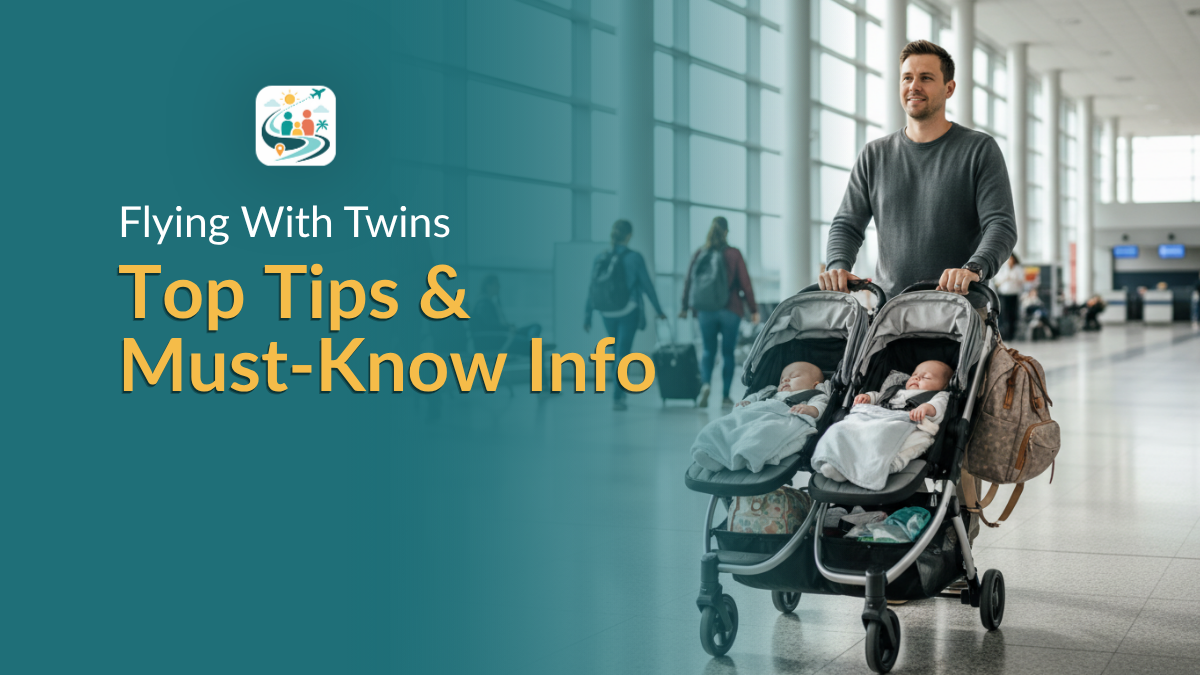
Parents worry about airline rules, crying babies, judgment from other passengers, and doing something wrong at the gate. Many lose sleep before the trip, replaying questions: Can I fly alone with twins? Will the airline let us board? What if both babies cry at once?
Most problems happen before the flight. Parents arrive at the airport unsure about rules, seating, or what airlines actually enforce. When expectations are clear, stress drops. This guide explains the rules in plain language so you feel prepared before you reach the airport. For the fundamentals that apply to any young child, start with our complete guide to flying with a baby or toddler.
Key takeaways (read this first)
- Airlines allow only one lap infant per adult. With one adult and two infants, one infant needs a paid seat.
- The rules, costs, and safety tradeoffs are covered in full in our guide to flying with a lap child.
- Flying alone with twins requires a paid seat plus a car seat. Confirm this before you book.
- A certified car seat is the safest option for children under 2 on a plane. The FAA recommends it for crash survivability, not just turbulence comfort.
- Baby liquids (formula, breast milk, baby food) are allowed through TSA. Declare them at screening.
- Gate agents enforce the one-lap-infant-per-adult rule strictly. Get your seating arrangement confirmed in writing before travel day.
Flying twins travel tips
Flying with twins is different from flying with one baby. Airlines have strict rules, and they enforce them. Policies can feel unclear, especially around lap infants and seating.
Plan early. Keep your setup simple. Ask for help when needed.
Plan flights ahead of time
Book early. It gives you better seat choices and helps you avoid tight connections.
Choose flights that align with your twins’ sleep schedule. Morning flights often work best for most infant and toddler schedules. Avoid very late flights if your twins get overstimulated easily.
One important note: this assumes your twins are on a synchronized schedule. If they’re not — or if they’re currently transitioning between nap stages — “their sleep schedule” may mean two different windows. For unsynchronized twins, aim for mid-morning and plan around activity and distraction rather than sleep.
Know the rules before flying with twins
Airlines allow only one lap infant per adult. This rule exists because each row has a fixed number of oxygen masks, counted per row. Two adults in the same row with two lap infants may still create a problem on some aircraft configurations. Confirm your specific seating arrangement with the airline before you travel.
The FAA recommends a certified car seat for all children under 2 on a plane. The reason is crash survivability, not turbulence. A lap infant during a hard landing or rapid deceleration is at significantly higher risk than one secured in a car seat. That context matters when you’re weighing whether to buy the extra seat.
If one adult flies with two infants:
- One infant must have a paid seat.
- That infant must use an FAA-approved car seat.
Seating scenarios for twins
Note: Airline policies vary. Confirm with your airline before you travel.
What happens at the gate if your setup is wrong
Gate agents enforce the one-lap-infant rule at their discretion. Some parents have shown up with two lap infants and one adult and been told to buy a seat on the spot. Walk-up seat prices at the gate are substantially higher than booking prices — often 50–150% more on domestic routes.
If both twins are lap infants and you’re flying alone, airlines typically require a second adult. Don’t rely on being waved through. Call the airline before your trip, explain your setup, and ask for written confirmation of what’s allowed. If you’re told something verbally that contradicts the published policy, ask for it in an email or via the airline’s messaging system.
Flying with twins alone

One adult cannot fly with two lap infants. One infant needs a paid seat and a certified car seat. Know this before you book, not at the gate.
For a full breakdown of managing security, boarding, and in-flight care on your own, see our guide on flying alone with two babies.
Bulkhead seats with twins
Bulkhead seats have extra legroom, which helps with space. Some bulkhead rows don’t allow car seats. Bassinets are limited and not guaranteed. Confirm with the airline before booking these seats.
Flight times
Pick flight times that align with naps when possible. Avoid late-night flights if your twins get overstimulated easily.
Packing for the flight with twins
The goal is to pack the essentials and stay hands-free.
Important documents
Keep all documents in one place:
- Boarding passes
- Birth certificates (if required)
- Insurance cards
Carry-on luggage
Your carry-on should include:
- Diapers and wipes
- Formula or breast milk
- Bottles or cups
- Pacifiers
- Snacks for toddlers
TSA allows formula, breast milk, and baby food through screening. Declare them before you reach the belt. The full TSA rules for breast milk and baby food cover quantities, swab testing, and what to expect. TSA may swab them for additional testing, which takes 2–5 minutes. Keep all baby liquids in one accessible pouch so you’re not unpacking everything.
Twin packing checklist (carry-on vs checked)
When both babies need something at once, fast access matters. Organize your carry-on with that moment in mind.
Entertainment
Bring small, quiet toys. Board books work well. Avoid toys that roll under seats.
Spare clothing
Pack at least one spare outfit per twin and one spare shirt for yourself. Spills happen.
Baby carrier
A baby carrier frees your hands in the airport and keeps babies calm. It also changes your TSA experience significantly — you may not need to remove the baby from a soft carrier depending on the scanner type, but be ready to. Ask the TSA agent before you step into the scanner.
See wearing your baby through TSA for how screening actually works with a carrier.
Double strollers
Most airlines allow gate-checking a double stroller. Some have size and weight limits. A lightweight stroller is easier to manage at the gate. See our step-by-step guide on gate checking a twin stroller for what to expect.
Car seats
A certified car seat is the safest option for babies on a plane. Check for the FAA aircraft approval label before you travel — not all car seats are approved for aircraft use. Our guide to FAA-approved car seats for airplanes lists what to look for and which models qualify. Car seats go in window seats. Confirm the specific seat assignment with your airline at booking.
Snacks and formula
Bring more than you think you need. Delays are common. A hungry baby in a delay is a harder problem than extra weight in your bag.
Getting through the airport with twins
Arrive early. Crowds and noise raise stress fast, and you need time for feeding, diapering, and security without rushing.
Our breakdown of how early families should arrive at the airport covers how these numbers shift with gear and child count.
Arriving early
Arrive at least 2 hours early for domestic flights. For international flights, 3 hours is safer with twins.
Check-in
Online check-in saves time at the airport. If you need help, airline staff at family check-in desks are usually the most helpful resource for confirming infant seating and stroller plans.
Getting through security with twins
Security is the part most parents fear, and it’s worth knowing the physical sequence before you get there.
The general order: fold the stroller before you reach the belt, not at it. Put the folded stroller on the belt. Place bags and the diaper bag on the belt. Walk through the scanner with whichever baby is in the carrier. Pick up the stroller and bags on the other side before folding out the carrier again.
If you’re alone with both twins and neither is in a carrier, ask a TSA agent before you reach the belt. Agents are allowed to help you manage bags through the belt — they can’t hold your baby, but they can assist with the physical logistics of moving your items. You can also ask a passenger behind you to push your stroller through the scanner while you walk through with a baby in each arm. Most people are willing when you ask clearly.
TSA PreCheck removes the laptop-and-liquids unpacking step, which makes a real difference with a double stroller and two babies. If you fly more than twice a year with your twins, it’s worth the $85 enrollment fee.
Airport flow for twins (simple timeline)
- Arrive early — buffer time for feeding and diaper change before security
- Check-in — confirm infant seating and gate-check plans
- Security — declare baby liquids; keep them in one pouch; know the stroller-fold sequence
- Terminal reset — diaper change, feed, let toddlers move before boarding
- Boarding — use family boarding to set up calmly before other passengers board
- Takeoff — feed or offer a pacifier to help with ear pressure
In the terminal
Change diapers before boarding. Feed babies when you can. Let toddlers move and burn energy — a tired toddler boards more easily than a wired one.
On board the flight with twins
Board during family boarding when it’s offered. It gives you time to install the car seat, stow bags, and settle before the aisle fills.
Keep essentials under the seat in front of you. Anything in the overhead bin is essentially inaccessible once you’re managing two babies.
Parents who have done this describe the same pattern: the flight is more manageable than the airport was. The hard part is behind you once you’re in your seats.
When both twins have a meltdown at the same time
This is the scenario parents fear most. It’s also the one that most articles skip over.
Two simultaneous meltdowns are different from two separate ones. You can’t physically comfort both babies at once, and each child’s distress can amplify the other’s. Here’s what actually helps:
Triage first. Address the twin who is closer to escalating out of your ability to manage — usually the one who is escalating faster, not necessarily the louder one. The goal is to stabilize one before both spiral.
Contain the second twin physically. Seat the second twin in the car seat or against your body while you attend to the first. Physical containment isn’t comfort, but it prevents a second simultaneous physical emergency.
Ask for specific help. Don’t ask a nearby passenger “can you help me?” — it’s too vague. Ask: “Can you hold this pacifier in his mouth for 30 seconds?” or “Can you keep this toy in her hands while I settle him?” People are more likely to help when the request is specific and brief.
Snack as a reset. A new snack or a completely unfamiliar toy introduced at the peak of the meltdown can interrupt the cycle. Keep one item specifically for this — something neither twin has seen before the flight.
The meltdown ends. Other passengers have lived through crying babies before. Your job is to get through 5 minutes, not to perform a perfect flight.
Installing a car seat
Install using the seat belt, following the car seat manual. Flight attendants can assist if you need help with the belt path. See our step-by-step walkthrough on how to install a car seat on an airplane. Confirm the seat is approved for aircraft use before the trip — check for the label that says “This restraint is certified for use in motor vehicles and aircraft.”
Lap belts and harnesses
Lap infants must be held during takeoff, landing, and whenever the seatbelt sign is on. Follow the seatbelt sign.
Changing diapers on the plane
Lavatory changing tables are small. Bring only what you need: 1 diaper, wipes in a small pouch, a changing pad. Everything else stays at your seat.
Feeding on the plane
Feed babies during takeoff and landing to help equalize ear pressure. Sucking and swallowing during ascent and descent reduces ear discomfort for infants who can’t do the Valsalva maneuver.
Bring familiar snacks for toddlers.
Hydration
Airplane cabins are dry, typically 10–20% humidity. Offer fluids more often than you would at home. Dehydration makes babies fussier and harder to settle.
Sleep on the flight
Sleep is harder on a plane than at home. This is especially true for twins on a synchronized schedule — the stimulation of a flight environment often prevents both from settling at the same time, and when one wakes and cries, it frequently wakes the other.
Familiar items help: a small blanket, a pacifier, a white noise app on your phone at low volume near their seat. Keep the routine as close to normal as you can.
If your twins are not fully synchronized, manage each independently rather than trying to force synchronization mid-flight. A twin who is genuinely tired will settle sooner if you follow their cues rather than trying to align them with their sibling.
Disembarking
Let the aisle clear. There’s no advantage to rushing off with twins and bags when the aisle is packed. Wait 3–4 minutes after the main flow, then take your time.
Jet lag with twins
Jet lag can affect twins differently, even identical ones. One twin may adjust to a new time zone faster than the other, which disrupts synchronization.
For cross-time-zone trips:
- Use daylight to reset schedules. Morning light is the most effective schedule cue for young children.
- Don’t try to force resynchronization immediately. Let each twin adjust at their own pace for 1–2 days, then gently merge the schedules.
- Expect 1 day of adjustment per hour of time zone difference for young children, roughly. A 3-hour shift typically takes 2–4 days to fully settle.
Plan low-activity days immediately after a time-zone flight. The first day is for recovery, not activities.
Flying with infant twins vs twin toddlers
Infant twins need more feeding and diaper management. Twin toddlers need more snacks, movement, and activities.
What changes on flights
If your twins are no longer infants but both under 3, see our guide on flying with two kids under three.
FAQs
Yes, when you follow airline rules and use proper seating. The FAA recommends a certified car seat for all children under 2. It’s safer than a lap infant position during turbulence and significantly safer in a hard landing. If your budget allows, buy the seat.
Usually yes, but it depends on lap infant rules and your aircraft’s row configuration. Two adults with two lap infants in the same row may be seated separately on some aircraft due to oxygen mask counts. Confirm with the airline when you book.
It depends on the ages and how many adults are traveling. Two infants with one adult means one infant needs a paid seat. Two infants with two adults can both be lap infants, though seating may not be side by side. Once twins are 2 or older, they each need their own seat.
Most airlines allow gate-checking double strollers at no charge. Check the airline’s size and weight limits before you travel — some carriers have restrictions that affect larger twin strollers. A compact or lightweight twin stroller is generally easier to manage at the gate regardless of policy.
Final thoughts
Flying with twins is manageable. Parents who know the rules, plan seating before they book, and prepare for security come out the other side less anxious than they expected.
The gate is where things go wrong for parents who didn’t confirm their setup in advance. Get that confirmation before travel day, and most of the hard part is already behind you.