





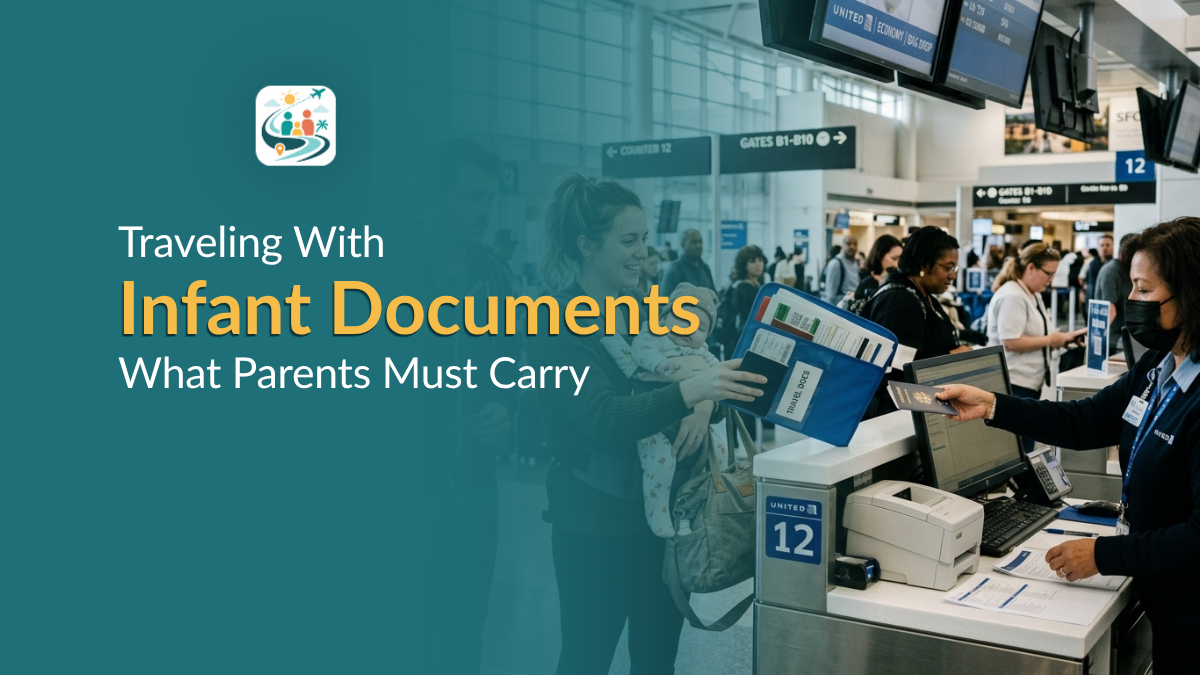
I still remember standing at the check-in counter with my four-month-old strapped to my chest, completely confident we had everything — until the agent asked for proof of her age and I realized our birth certificate was sitting on the kitchen counter at home. We weren’t denied boarding that day, but it was close. The panic I felt in that moment made me obsessive about infant travel documents for every trip since.

Airline staff can and do ask for infant paperwork. Not having it ready can unravel your entire trip before it starts. And in my experience, they ask more often than most parents expect — particularly on international flights and when a baby looks close to the two-year lap infant cutoff.
Most parents don’t think about infant travel documents until they’re already in the thick of trip planning — and by then, some documents take weeks to obtain. This guide covers exactly what to carry, when you need it, and what to do when something goes wrong.
Quick tip: documents needed when flying with a lap infant
Most airlines allow babies under 2 years old to travel as lap infants — the baby sits on a parent’s lap without a separate purchased seat. Airlines will often ask parents to show proof of the baby’s age or identity before allowing travel, so having the right documents within easy reach matters.
Always carry at least one official document confirming your baby’s birth date. The hierarchy matters here: a birth certificate and passport carry more weight than a hospital birth record, and some airlines and immigration officers won’t accept informal hospital documents at all. The most commonly accepted options:
- Birth certificate
- Passport
- Hospital birth record (domestic only; rarely accepted internationally)
- Medical records showing birth date
Many first-time parents go through several flights without being asked for anything. That doesn’t mean the next airline won’t ask. Carrier policies vary, staff discretion varies even more, and the one time you’re asked without documents ready is enough to make every subsequent trip stressful. Keep infant documents in a dedicated section at the top of your carry-on — not in checked luggage, where you can’t reach them during check-in, security, or boarding.
Documentation required for lap infants
The documents airlines most commonly accept:
- Original birth certificate
- Copy of birth certificate
- Infant passport
- Government-issued identification
Airlines pay closer attention to age verification when a child appears close to the 2-year cutoff. If your baby is around 18 to 24 months, come prepared with clear documentation. Even if your booking went through without a document check, the gate agent may still ask.
Proof of age
Airlines use proof of age to confirm your infant qualifies for lap seating or the child ticket pricing applied during booking. If they can’t confirm it, they have grounds to deny boarding.
A birth certificate is the strongest document for domestic travel. It shows your baby’s full legal name and date of birth in an official format. Some airlines accept a hospital birth record for very young newborns, but those informal documents rarely hold up for international travel. Carry both the original birth certificate and a photocopy. Some airlines won’t accept copies alone.
One thing worth checking before you travel: make sure your baby’s name is spelled identically across every document and matches how you booked the ticket. Name mismatches — a middle name omitted, a hyphenated surname split differently, a typographical error on the birth certificate — are one of the most common check-in problems families don’t anticipate. If you find a discrepancy, contact the airline before travel to understand their policy on minor variations. Some will let it pass; others won’t.
Traveling with a newborn
Traveling with a newborn before the official birth certificate arrives is more common than you’d think. For domestic travel, some airlines accept hospital birth records or medical documentation showing the birth date — but policies vary by carrier, so call ahead. If you need to travel in the first few weeks and the birth certificate hasn’t arrived, contact your county vital records office about expedited issuance. Most states offer it; costs typically run $10–$50 and turnaround can be as fast as same-day at some offices, though it varies significantly by state.
For international travel, a passport is almost always required even for newborns. Start the application process as early as possible if travel is planned soon after birth.
Passport (for international flights)
Every infant needs their own passport for international travel. Babies cannot travel on a parent’s passport. This applies in virtually every country.
If your family is planning an international trip, start the passport application before anything else — not in the final weeks before departure. The State Department’s current standard processing time is 6–8 weeks; expedited service runs 2–3 weeks but costs extra and isn’t guaranteed. Most experienced family travelers apply at least 3 months out. During peak periods (spring and summer), processing slows further.
The application requires:
- Completed passport application form (DS-11)
- Baby’s birth certificate
- Passport photos of the baby
- Identification documents of both parents
- Proof of parental relationship
Both parents must normally appear in person when applying for a baby’s passport. This rule exists to protect children from international child abduction. It’s non-negotiable in most cases.
Getting the passport photo right
Infant passport photos are harder than they sound. The State Department requires a white background, no shadows on the face, eyes open, baby facing forward, and no parent visible in the frame — which is a significant challenge with a newborn who can’t hold their head up.
The most reliable DIY method: lay a white sheet on the floor, place your baby on it, stand directly above them, and photograph from overhead. This eliminates background and shadow problems. Take 20–30 shots and sort them afterward. Professional photo services at pharmacy chains frequently fail with infant photos because their staff aren’t trained for the specific requirements — if you use one, ask them to take multiple attempts and verify the dimensions (2×2 inches) before you leave.
Get 4–6 prints made. The passport application needs 2, but first attempts are often rejected and having extras avoids a return trip.
When both parents cannot attend
If one parent can’t make the appointment:
- Form DS-3053 allows one parent to give notarized consent for the other to apply alone
- Form DS-5525 covers situations where one parent cannot be located
- Court custody documents may allow a single-parent application in certain circumstances
Sort out these forms well before your travel date. Incomplete paperwork is the most common reason infant passport applications get delayed.
Visa requirements for infants
Some countries require visas for babies. The rules depend entirely on your destination and your child’s citizenship. Check your country’s foreign affairs or state department website for the specific entry requirements of every destination before booking flights — these rules change, and the consequences of arriving without a required visa range from being turned back at the border to significant fines.
Dual citizenship
Infants with dual citizenship face a complexity that families sometimes don’t discover until they’re at the border. Several countries — including Mexico and Canada — require their citizens to enter and exit using that country’s passport, regardless of which other passport the child holds. An immigration officer in Mexico who identifies your child as a Mexican citizen will expect a Mexican passport, and arriving without one can mean being held at immigration.
If your baby holds citizenship in more than one country, check the entry and exit laws for every country on your itinerary before you travel. This is worth spending real time on — a few hours of research is considerably less painful than an immigration hold with a tired infant.
Parental consent
Many countries require documented parental consent when a child travels without both parents present. This applies whether one parent is traveling solo with the baby, or the child is traveling with grandparents, relatives, or another guardian. Without it, immigration officers at many international borders can deny entry or exit.
A complete parental consent letter should include:
- Child’s full name and birth date
- Full names of both parents or guardians
- Travel dates and destination
- Contact information for both parents
- Signatures of both parents
Have the letter notarized for international travel. In countries with formally codified child protection laws — South Africa is the most frequently cited example, but the list is longer — a notarized letter carries specific legal weight. In other countries, notarization doesn’t change how the letter is treated legally, but it typically reduces additional questioning at the border.
One practical note: if you’re traveling to Mexico and your letter is in English, some immigration officers will request a Spanish version. This isn’t a universal requirement and isn’t formally mandated in all cases, but it happens often enough that having a Spanish translation ready is worth the effort for Mexico travel.
Traveling alone as a single parent
Single parents traveling internationally with a baby should prepare for additional scrutiny at immigration, particularly in countries with strict child protection laws — though scrutiny of single-parent travel is common in many destinations, not just formally codified ones.
Carrying your custody agreement or a letter from the other parent confirming travel consent isn’t just helpful; in many destinations it’s effectively required even if not officially mandated on paper. If you have sole legal custody, carry certified court custody documents — not just photocopies — on every international trip. These are your proof that you have the legal right to travel with your child without the other parent’s presence. An immigration officer who asks questions has no way to verify your situation without them.
A few nuances most articles skip: a separation agreement is not the same as a court-issued custody order, and some countries treat them very differently at the border. For any country that has formal child protection entry requirements, consider whether your custody documents need apostille certification — this is a form of authentication that some countries require for foreign court documents to be legally recognized. An afternoon with a family law attorney before an international trip is worth considering if your custody situation is at all complicated.
Traveling with guardians or relatives
When a baby travels with grandparents, aunts, uncles, or any adult who isn’t a legal parent, that adult should carry:
- Signed parental consent letter from both parents
- Copies of both parents’ identification
- Child’s birth certificate
- Guardian’s own identification
Deceased parent or unknown parent
If one parent listed on the birth certificate is deceased or genuinely cannot be located, carry documentation of that situation: a death certificate, or a court declaration if the parent’s whereabouts are formally unknown. Immigration officers in countries with strict child protection laws will ask. Having documentation that explains the situation turns a potentially long conversation into a quick one.
Will the airline actually ask for documentation?
Maybe not every time — but often enough that assuming they won’t is a real gamble.
Airlines are most likely to check closely when the baby appears close to the 2-year lap infant cutoff, when the flight is international, and when the carrier’s own policies require stricter age verification. The fact that one airline didn’t ask on your last trip doesn’t mean the next one won’t. Carrier policies are genuinely different from each other. Delta, United, American, Southwest, Spirit, and major international carriers each have different stated policies on infant age verification — and their actual enforcement practices don’t always match what’s written on their websites. For any flight where it matters, call the airline directly and ask specifically what documents they require for a lap infant. Note the date and agent name. That call record won’t override a gate agent in the moment, but it’s better than nothing.
What to do if you’re at the gate without documents
This is the scenario most articles don’t cover. Here’s what actually happens and what your options are.
Gate agents have significant individual discretion. There is no universal airline rule about what happens next, and your outcome depends considerably on the specific agent and the specific carrier’s culture around these situations. A few things worth knowing:
If you have a digital copy of the birth certificate accessible on your phone, show it immediately and ask to speak with a supervisor if the agent won’t accept it. Many carriers treat digital copies as acceptable at their discretion even if their written policy says otherwise.
Buying a separate seat for the baby on the spot — converting from lap infant to ticketed child — sometimes resolves a document dispute, because a seat purchase removes the age verification requirement. This is expensive and doesn’t always work, but it’s worth asking.
Travel insurance almost never covers denied boarding due to missing documents. Don’t count on it.
If you’re traveling domestically and have any digital access, some county vital records offices have same-day or next-business-day certificate issuance available. In a genuine emergency, it’s worth calling before accepting that you’re stuck.
Smart backup documents to carry
Keep physical and digital copies of everything. For digital copies, save them offline — cloud storage that requires an internet connection is inaccessible when you need it most (international travel, no data, airport wifi that requires payment). Save PDFs directly to your phone’s local storage or a notes app that works offline.
The hierarchy for backups:
- Physical copies are more reliable than digital for most checkpoints
- Digital copies on local phone storage are more reliable than cloud-only storage
- A photo in your camera roll is a last resort, not a plan
Also carry:
- Travel insurance information (know what it covers before you need it — most policies don’t cover document-related denied boarding)
- Pediatrician contact details and any relevant medical records for the baby
Canada and Mexico travel exception
Children under 16 traveling to Canada or Mexico by land or sea may not require a passport in all cases. Alternatives that may be accepted:
- Birth certificate
- Consular Report of Birth Abroad
- Naturalization certificate
This exception applies to US citizens traveling by land or sea only. Air travel to both countries requires a valid passport regardless of age. Non-US-citizen infants need their own travel documents regardless of mode of travel — the exception is citizenship-specific, not age-specific.
Confirm the specific entry requirements before your departure date. These rules change.
Bottom line
Carry proof of age on every trip. Bring a passport for any international travel. Pack consent or custody paperwork whenever you’re traveling without the other parent. Keep both physical and offline digital copies of everything. Put it all somewhere you can reach in under 30 seconds.
The families who have the worst experiences at the check-in counter are almost always the ones who assumed they wouldn’t be asked. The ones who travel smoothly prepared early and kept everything organized. That gap in outcomes is entirely preventable.


