


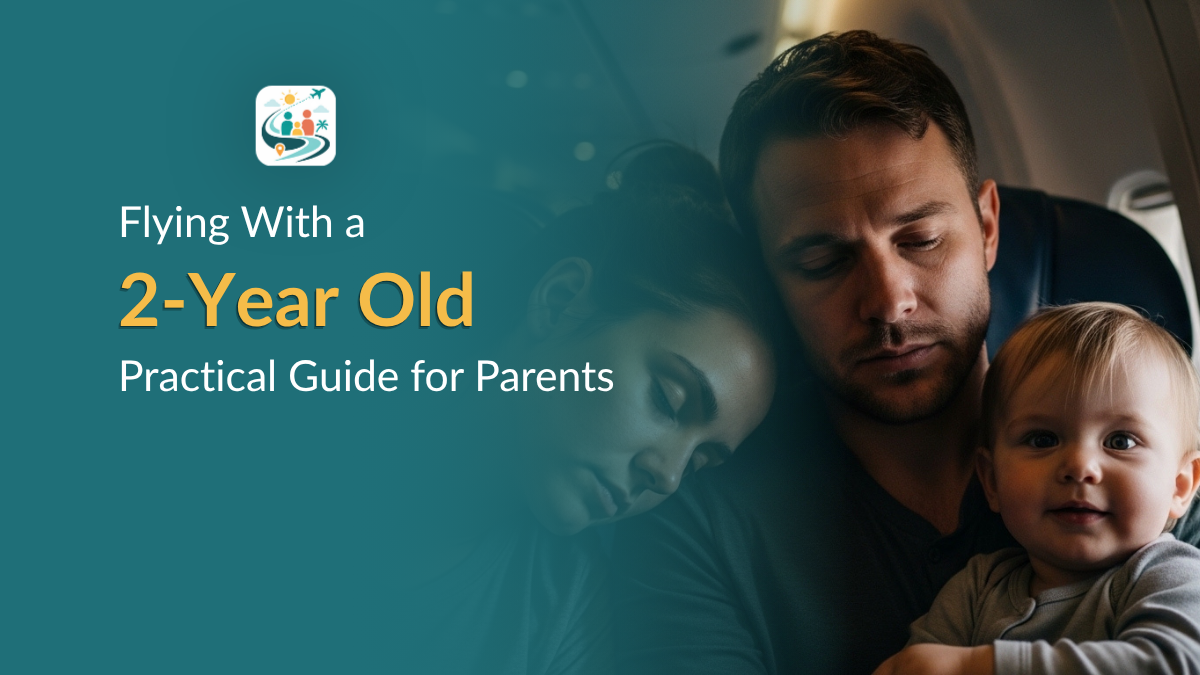
I’ve been on a red-eye with my toddler when things went smoothly — she drifted off 30 minutes after takeoff and woke as we were descending. I’ve also been on one where she was awake, wired, and increasingly unhappy from wheels-up to landing. The difference wasn’t which child I brought. It was timing, preparation, and a realistic idea of what I was actually signing up for.
Overnight flights with toddlers are rarely perfect. Success doesn’t mean a full night of sleep. It means having a plan, knowing your child’s limits, and staying functional when things go sideways. For the fundamentals that apply to any flight, start with our complete guide to flying with a baby or toddler.
Key takeaways
- Your toddler’s sleep associations at home are the strongest predictor of how a red-eye will go
- Overtired toddlers sleep worse on planes — keep naps normal the day of the flight
- The car seat decision is a real safety trade-off, not just a comfort preference
- Pack for a sleepless flight and treat any sleep as a bonus
- Solo parents face different logistics — the standard advice doesn’t fully apply
- The 48 hours after landing are often harder than the flight itself
Should you take a red-eye flight with a toddler?

There’s no universal answer, but there are clearer signals than most articles admit.
A red-eye is more likely to work if your toddler falls asleep independently — meaning you put them down awake at home and they settle themselves. Toddlers who need nursing, rocking, or parental presence to fall asleep rely on associations the plane can’t replicate. At 1 AM in a dark cabin, there’s no crib, no bedtime routine, no familiar ceiling. If sleep at home depends on those things, the flight probably will too.
A few other honest indicators:
Red-eyes are more viable when:
- Your toddler has slept reasonably well on at least one previous flight
- You have a low-activity day after landing
- You’re traveling with a second adult
- The flight is 6+ hours on a wide-body aircraft with bassinets available
Red-eyes are harder when:
- Your toddler is between 8 and 18 months (separation anxiety peaks and sleep associations tend to be strongest)
- You’re flying solo
- You need to function immediately after landing
- Your toddler is currently in a nap transition — there’s no reliable sleep window to align with
Many parents book red-eyes to save money or preserve daytime hours at the destination. That’s a legitimate reason. It just means going in with a clear plan and no illusions about guaranteed sleep.
Quick decision guide
If a red-eye isn’t the right call, our guide to the best time of day to fly with a toddler compares every departure window.
How to screen your specific toddler before booking
The logistics questions above are easy to answer. The harder question is whether your specific child will cope — and that comes down to behavioral profile, not age.
Sleep association type is the most predictive variable. Toddlers with independent sleep associations are meaningfully better red-eye candidates than those who need nursing or rocking. The plane can’t replicate those associations, and their absence at 2 AM in an unfamiliar seat tends to produce distress rather than sleep.
Stress response pattern matters too. Some toddlers go quiet and withdraw when overstimulated. Others escalate and get louder. The withdrawer is generally a better candidate. If your toddler’s default response to novelty is to climb on things and demand more stimulation, a darkened cabin at midnight won’t settle them.
Sensory sensitivity is worth thinking about before you book. Cabin humidity runs between 10–20%, far below the 40–60% of a typical home. Low humidity dries nasal passages and makes breathing uncomfortable — a mechanical barrier to sleep that has nothing to do with behavior. Cabin ambient noise during cruise sits around 75–85 decibels. Toddlers who are sensitive to noise or physical discomfort are working against the environment all night.
Previous flight behavior is the best concrete predictor available. A toddler who was calm on two previous daytime flights has a different profile from one who wasn’t. If you haven’t flown with your toddler yet, a daytime flight first is worth considering before committing to a red-eye.
The survival timeline
The sequence below is organized around your toddler’s physiological state. What matters is hitting the sleep window — the 20–45 minute period when sleep pressure is high enough to override the cabin environment. Miss it, and you’re dealing with an overtired toddler for the rest of the flight.
Afternoon (day of flight)
Keep naps normal. Don’t skip them hoping your toddler will be tired enough to sleep on the plane — overtired toddlers sleep worse, not better. A toddler who skips their afternoon nap doesn’t arrive at bedtime calm and ready. They arrive wired, cortisol spiked, and the overtiredness spiral starts before you’ve boarded.
Pre-airport
Feed a proper meal before you leave. Airport food is expensive, slow, and unpredictable. A toddler who boards hungry will demand snacks exactly when you need quiet.
Airport
Let them move. Find open floor space in a gate area and let them run it out. 20–30 minutes of real physical activity before boarding is worth more than any toy you packed.
Watch your toddler’s energy during this window. If tiredness cues appear — eye rubbing, slowing down, leaning on you — the sleep window is opening. From that point you have roughly 20–40 minutes before it closes into overtiredness. If boarding is delayed, keep stimulation slightly higher than feels right. A toddler held quietly in a waiting posture during a 45-minute delay often crosses into overtiredness faster than one still moving.
Boarding
Diaper change or bathroom stop first. Once you’re in your seat with bags overhead and passengers filing past, leaving is difficult.
Start reducing light exposure at the gate. Overhead fluorescents and screen blue light delay melatonin. Dim your phone, skip the tablet, let the gate noise be the stimulation rather than adding to it.
After takeoff
Pajamas go on now. This is the most effective sleep signal you can give a toddler on a plane — it works because it’s the same signal you give at home every night. Comfort item out. Voice drops. Shade down.
Watch for ear discomfort during ascent. Swallowing helps. A bottle, pacifier, or small snack during the first 10–15 minutes of climb handles this for most toddlers. If your child has had ear pain on previous flights, ask your pediatrician before this one about whether a decongestant is appropriate.
Mid-flight
If the toddler is asleep, don’t touch them. Low-frequency seat vibration during cruise can help maintain light sleep. Resist the urge to reposition them.
If they’re not asleep, go to quiet lap play. Books, soft toys, sticker pages. Snacks in slow rotation. Keep your voice low and movement minimal. The goal isn’t entertainment — it’s low stimulation until they tire themselves down. Our full guide to helping a toddler sleep on a plane covers routines and comfort items that work in a cabin.
Screens are a last resort, and not at the point when overtiredness is already escalating. Blue light during a cortisol spike tends to extend the wired state rather than resolve it. Screens work better as a calm maintenance tool once a toddler has plateaued in a manageable state.
Descent
This is the riskiest moment for a toddler who has finally fallen asleep.
Descent pressure changes are more intense than ascent and concentrate in the last 20–30 minutes of flight. A toddler who is half-asleep when this begins can’t swallow voluntarily and may wake in pain and disorientation — a combination that produces very hard-to-stop crying in a confined space.
Consider waking your toddler gently before descent begins rather than letting pain do it. A toddler who wakes to your face and a familiar snack handles pressure changes far better than one jolted awake by discomfort in a dark cabin.
If ear pain escalates: gentle jaw movement (chewing, yawning, sucking), upright position, physical closeness. If crying is clearly pain-related, ask the crew — they’ve seen this and can sometimes suggest positioning adjustments or get warm water for a bottle. See our full guide to toddler ear pressure on flights for prevention and what to try when nothing works.
Landing
Expect emotions. Landing after a disrupted night is disorienting regardless of how much sleep happened. Food and water first. Keep your voice calm. The terminal is not the moment to assess how the night went.
Seat selection
Two-parent families: the most functional configuration on a red-eye is usually one parent at the window with the toddler between both adults. The toddler has a contained space, access to both parents, and the window-side parent can manage the shade and create a dark corner for sleep.
Solo parents: the window-vs-aisle calculus is different alone. A window seat contains the toddler better but traps you. An aisle seat gives you mobility — bathroom access without climbing over strangers, faster response when you need a flight attendant. On a red-eye over 5 hours, aisle is usually the better solo choice.
Bulkhead rows give floor space for movement and play. Request them at booking — they fill quickly on family-heavy routes.
The car seat decision
The standard framing — “helpful for some toddlers, stressful for others” — understates what’s actually a safety trade-off.
The FAA’s position is that lap children have no protection during severe turbulence. Turbulence-related injuries are the primary aviation risk for young children, and a child on a lap has nothing to hold them in place during an unexpected drop. The American Academy of Pediatrics recommends a separate seat with an appropriate restraint for all children under 40 pounds. Our guide to car seats on airplanes covers choosing and using one.
The honest case for bringing it: Some toddlers sleep significantly better in the familiar confinement of a car seat. If your toddler naps well in the car regularly and settles easily there, a red-eye in their own seat with the car seat installed is worth the logistical effort. It’s also the safest arrangement available.
The honest case against: Gate-checking a car seat means it goes in the cargo hold and may arrive damaged. A padded travel bag reduces but doesn’t eliminate this risk. See gate-checking a car seat for how to protect it and what to do if it arrives damaged. Managing a bulky car seat through a late-night airport alone is genuinely difficult. And some toddlers who sleep well in the car don’t transfer that behavior to an aircraft — you won’t know until you’re already on the flight.
A middle option: the CARES harness is an FAA-approved aircraft harness for children 22–44 pounds. It fits in a carry-on, installs in 60 seconds, and gives you restraint without the bulk of a full car seat. For toddlers over 22 pounds who don’t have a strong car-seat sleep preference, it’s often the better red-eye choice.
When your toddler won’t sleep: the overtiredness stages

Stage 3 — active crying. Screens introduced at this stage tend to extend the problem. Blue light and stimulation add to the cortisol rather than resolving it. Walking the aisle in low light, repetitive gentle motion, and firm physical hold (pressing them against your body) work better. This stage is time-limited even when it doesn’t feel that way. See managing toddler tantrums on a plane for more on de-escalating in a confined space.
Overtiredness on a night flight has distinct stages that require different responses. Knowing which stage you’re in tells you what to do — and what not to do.
Stage 1 — the second wind. Your toddler appears suddenly alert and energetic despite being well past their sleep window. This is a cortisol spike, not genuine energy. Drop all stimulation immediately: no new toys, no screens, no movement. Low voice, dim everything, physical closeness.
Stage 2 — hyperarousal. Clingy, easily upset, resistant to everything you offer. Don’t try to entertain through this. Skin contact, a very low voice, and minimal movement work better than distraction here. This stage typically lasts 15–30 minutes and can’t be significantly shortened.
Stage 4 — the crash. Once a toddler reaches genuine exhaustion, they go down. The mistake here is trying to help by rocking or stimulating. Stillness and low stimulus let this stage do its work.
Solo parent red-eyes
Everything above is harder alone. A few logistics that two-parent advice skips entirely:
The bathroom problem. If your toddler is asleep and you need to use the bathroom, your options are: take them with you (aircraft bathrooms fit a parent and a small toddler, barely), ask a neighboring passenger to keep watch for 2 minutes, or ask a flight attendant to stand nearby. On a half-full flight, crew will often do this without hesitation. On a full flight, a specific, brief, clearly framed ask to a neighbor works most of the time.
Eating. On a solo red-eye, you probably won’t eat a proper meal. Accept this before you board. Eat well before the flight, and keep a snack in your pocket rather than the overhead bag.
Crew. Tell them when you board that you’re alone with a toddler. Most crews on long-haul routes will check in on you, offer to warm a bottle, or flag an empty row if one opens up after takeoff. A brief conversation at boarding establishes you as someone they’ll look out for.
The recovery day. After a solo red-eye, you’re landing with sleep debt and no one to hand off to. A genuine low-activity day one isn’t optional — it’s part of the cost of the decision.
The 48 hours after landing
No article covers this part. It’s where the real cost of a red-eye shows up.
Day 1: Adrenaline often masks the sleep debt initially. Your toddler may seem functional for the first few hours. Don’t over-schedule day one on that basis.
Day 2: Usually the hardest. Sleep-deprived toddlers don’t present as sleepy — they present as hyperactive, emotionally dysregulated, and with a very short frustration tolerance. Meltdowns over small things are the main sign. Keep day 2 low-stimulation regardless of how day 1 went.
Day 3: Most toddlers stabilize here if naps and bedtimes have been protected. The goal from landing is to shift to the destination schedule as quickly as possible — not to chase the home time zone.
Nap reconstruction: A toddler who didn’t sleep on the flight and is now in a new time zone may reject the first 2–3 naps. Keep the environmental cues consistent (dark room, white noise, comfort item) and attempt naps at the regular local time rather than guessing at a shifted schedule.
Passengers and crew
Most passengers on red-eyes have noise-canceling headphones or are asleep. The number actually disturbed by a crying toddler is usually smaller than the anxious parent imagines, and people are generally more tolerant than expected at 1 AM.
When a passenger says something directly: stay calm, keep it brief, don’t over-apologize. “I know, I’m working on it” is usually enough. Extended explanations escalate; brevity de-escalates.
Crew can’t require you to silence your child. They can offer help, suggest positioning changes, or find you a different seat if one is available. If crew are dismissive, ask for the cabin manager. Long-haul international crews are generally more experienced with families and more willing to help than domestic short-haul crews.
The goodie-bag approach (earplugs and candy for surrounding passengers) circulates on social media as a goodwill gesture. Honest assessment: it won’t prevent complaints, but it does change the emotional tone of interactions if problems occur. Whether the prep is worth it is a personal call.
Overnight packing list
- Pajamas and a warm layer (cabins run cold and variable)
- The comfort item they actually sleep with at home
- Snacks in slow rotation: something to open every 20–30 minutes if needed
- Water in a no-spill cup
- 3–4 quiet activities: board books, soft toys, sticker pages
- Extra clothes for the toddler; extra shirt for you
- Wipes, diapers or pull-ups, small changing pad
- White noise app downloaded offline
- CARES harness if your toddler is 22–44 pounds and you’ve decided against the car seat
- Our full carry-on packing list for toddlers covers everything beyond the overnight essentials.
Leave the tablet in the bag until you need it. Keeping it unused preserves it as a genuine last resort.
FAQs
For some, yes. The main indicator is how your child falls asleep at home. Toddlers who settle independently are significantly better red-eye candidates than those who need nursing or rocking. A toddler who has managed reasonably well on previous daytime flights is a better candidate than one who hasn’t flown before. For toddlers with strong sleep associations, sensory sensitivities, or who are currently in a nap transition, daytime flights are almost always the better choice.
Plan for this before you board. Pack enough quiet activities and snacks to fill the flight without sleep. Keep stimulation low throughout — not because it guarantees sleep, but because it keeps your toddler in a calmer state whether they sleep or not. The overtiredness stages above tell you what to do if things escalate. Arriving sleep-deprived is manageable with a recovery day planned. Arriving without one planned is harder.
It depends on your toddler’s sleep patterns and the flight. The FAA and AAP both recommend a restraint for children under 40 pounds — a lap child has no protection in severe turbulence. If your toddler naps well in their car seat at home, bringing it on a long red-eye is worth the logistical cost. If not, the CARES harness (22–44 pounds) gives you restraint without the bulk. Gate-checking a car seat carries a real damage risk; use a padded travel bag if you check it.
Final thoughts
The parents who do best on red-eyes aren’t the ones with easy sleepers. They’re the ones who went in with a realistic picture of the night and a specific response ready for each stage.
Pack for a sleepless flight. Treat any sleep as a bonus. Know the overtiredness stages. Build a recovery day into the trip. And if you’re flying solo, tell the crew early — it’s the single easiest thing you can do to get help when you need it.