





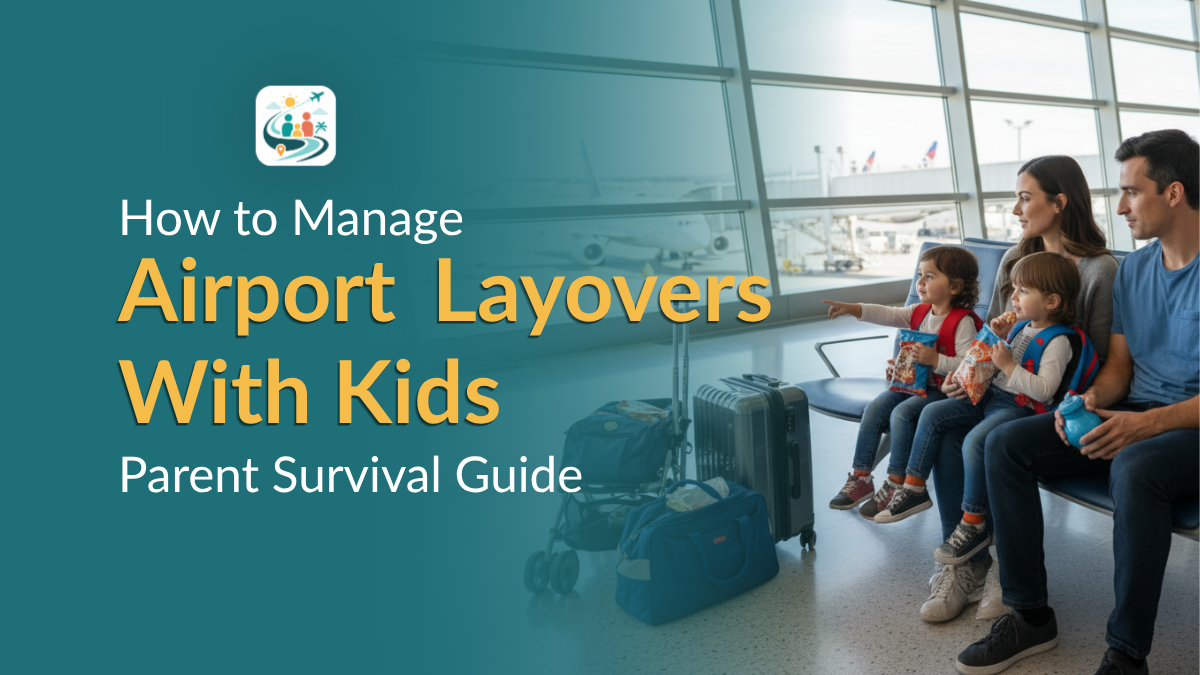
A long layover with kids rarely matches the calm break parents picture. Children get bored, hungry, tired, or overstimulated by crowds and noise. Parents juggle luggage, documents, snacks, and safety at the same time. Public meltdowns and tight connections are the two worries that come up most.
Layovers get easier with a routine: movement breaks, snack timing, a quiet activity, and gate preparation before boarding. None of this makes a layover effortless, but it removes most of the chaos.
Quick layover survival tips for parents
- Feed kids before they get hungry, not after
- Let kids move every 20 to 90 minutes, depending on age (see the age table below)
- Introduce a new toy or activity partway through, not all at once
- Check your next gate as soon as you land
- Balance screen time with physical movement
- Build in a rest period for toddlers
- Keep travel documents in one dedicated pocket or pouch
Why layovers are hard on children
Kids need activity and structure, and airports offer neither by default: they’re noisy, crowded, and unfamiliar. That combination raises a child’s stress and a parent’s along with it.
Common problems parents run into:
- Kids get bored quickly once the novelty of the airport wears off
- Hunger and fatigue hit faster than expected, especially after a flight
- Long terminal walks tire out young legs before the next flight even starts
- Security lines add stress at the exact moment kids are already worn down
- Loud gate areas overstimulate younger travelers
- Parents feel embarrassed or judged during a public meltdown
The layover length on your ticket isn’t the layover length you get

Airlines publish a minimum connection time (MCT) for every airport pair: the shortest legal gap between two flights. That number assumes an adult walking at a normal pace with carry-on bags only. It does not account for a stroller, a car seat, a security line with a double buggy, or a toddler who refuses to walk the last 200 meters to the gate.
A few patterns worth knowing before you book or plan around a connection:
- International-to-domestic connections in the US (Miami, Houston, Dallas-Fort Worth) usually require you to clear immigration and customs, recheck bags, then go through security again, even if your onward flight is on the same airline. That alone can take 45 to 60 minutes before you’ve reached a gate.
- Airports with train or bus transfers between terminals (Frankfurt, Atlanta, Istanbul) add a fixed 15 to 20 minutes that a printed connection time may not obviously account for.
- Stroller gate-check and re-collection adds time on both ends: a few minutes to hand it over, and often more to get it back if ground crew brings it to baggage claim instead of the jet bridge on an international arrival.
A rule of thumb: treat the airline’s minimum connection time as the floor, not a workable target. If the MCT is 60 minutes and you’re traveling internationally with a stroller, the layover that actually functions for a family is closer to 2 hours.
Is a longer layover worth booking, even if it costs more?
Booking a layover is a trade-off most parents make once, at the point of purchase, and then have to live with for the whole trip.
A short connection close to the MCT saves time overall but leaves no buffer if the inbound flight is delayed, security lines are long, or a child needs an unplanned bathroom stop. A missed connection with kids costs far more time, and more stress, than the time saved by booking tight.
A very long layover, 5 hours or more, avoids that risk but introduces a different one: an overtired, overstimulated child by the time the second flight boards, plus the cost of a lounge pass or meals to fill the time.
Where the balance tends to land for a family flying with young kids: enough buffer to survive one delay, roughly double the airline’s minimum connection time, without stretching so long that boredom or overstimulation on the ground erases the benefit. A red-eye layover changes this again, since a long overnight wait with a tired toddler is a different problem than a long daytime one with access to a play area.
None of this is fixed. A 6-year-old who’s flown before tolerates a long layover better than a 2-year-old on their first flight, so the right length depends on the child, not just the schedule.
Layover strategy by length
Short layovers (0 to 60 minutes)
A short connection leaves no room for detours. Priorities: safety, speed, and having documents ready.
- Use the restroom immediately after landing
- Refill water bottles if there’s a fountain on the way
- Confirm the next gate the moment you’re off the jet bridge
- Offer a quick, no-mess snack (crackers, a banana, a pouch)
- Have boarding passes and IDs out and accessible before you reach the gate
Long layovers (3 to 6 hours)
A simple cycle works better than trying to fill the whole window with activities:
- Movement break (walk the terminal, use a play area if one exists)
- Meal or snack
- Quiet activity (books, coloring, low-volume tablet time)
- Rest period
- Boarding preparation, 30 to 40 minutes before the gate closes
Overnight layovers (6+ hours): hotel, sleep pod, or waiting it out
Three options come up for overnight layovers, and each carries a real cost, not just a comfort difference.
Airport hotel. Only realistic if the layover is inside a country or transit zone you’re allowed to leave without a separate visa. Some countries require a transit visa even for a short hotel stay outside the terminal, so check this before you count on it, not after you land. Factor in the time to re-clear security on the way back in, which can be another 30 to 60 minutes depending on the airport.
Sleep pod or airport capsule hotel. Available in a limited number of hubs (Istanbul, Singapore Changi, Dubai, Doha) and stays inside the transit zone, so there’s no visa question and no re-entry security line. The trade-off is cost per hour and limited availability during peak overnight hours.
Staying in the terminal. Free, and sometimes the only option at airports without pods or nearby hotels. Works better with a travel blanket, a familiar pillow, and a seating area away from the main concourse, since gate lighting and announcements rarely stop overnight.
A rough threshold: below 8 hours, a sleep pod or a quiet terminal corner usually makes more sense than a hotel once you count transfer and security time both ways. Above 8 hours, especially overnight with a toddler, a hotel bed tends to be worth the added cost and logistics.
Gate logistics
- Check gate information as soon as you land, not after clearing the terminal
- Confirm whether the connection needs a terminal transfer by train, bus, or walk, since some hub airports (Atlanta, Dallas-Fort Worth, Frankfurt) require 15 to 20 minutes just to move between terminals
- Monitor the departure board or airline app for gate changes; they’re common in the last hour before boarding
- Ask airport staff directly if a transfer method isn’t obvious. Signage varies a lot by airport
What to do if you’re going to miss the connection
Most advice covers how to avoid a missed connection. Less of it covers what to do once you already know you’re going to miss it, which is the moment parents are least prepared for.
- Rebook before you run. The gate agent at your arrival gate usually can’t rebook you onto a different flight. Open the airline’s app the moment you know you’ll miss the connection; app rebooking is often faster than a service counter line, especially at a big hub during peak hours.
- Split the tasks between two adults if you can. One handles the phone or app and the rebooking conversation, the other stays with the kids and manages food, bathroom, or a meltdown. Trying to do both at once tends to take longer and raise everyone’s stress.
- Know what you’re owed before you ask. In the EU, EU261 sets compensation and rebooking rules for delays and cancellations, including hotel and meal vouchers past certain thresholds. In the US, the Department of Transportation’s rules are different and generally weaker on cash compensation, though most major US airlines will still rebook, and some offer meal or hotel vouchers for controllable delays. The rules differ enough by region that it’s worth checking the specific airline’s contract of carriage rather than assuming one country’s rules apply elsewhere.
- Ask about interline and codeshare options. If your missed flight was on a codeshare, the operating airline sometimes has more seats available than the marketing airline’s own booking system shows. A phone agent or app chat can check this even when the gate agent says a flight is full.
- Reset before your child boards the replacement flight. A rebooking process can take 30 to 90 minutes of standing or waiting. Build in 10 minutes at the end for food, a bathroom stop, and a calm moment before boarding again, rather than rushing straight from the counter to the gate.
The stroller and car seat gate-check risk
Gate-checking a stroller or car seat is standard advice, but it comes with two problems competitors rarely mention.
Misrouted equipment. On an international connection, a gate-checked stroller sometimes goes to baggage claim instead of coming back to you at the jet bridge, especially if ground crew treats the arriving flight as an international arrival for baggage purposes even though you’re connecting. If this happens, you may need to clear the item through baggage services before you can leave, which can take longer than the layover itself.
Damage disputes. Car seats and strollers get damaged in gate-check bins more often than checked luggage, and airlines vary widely in how they handle claims: some replace a damaged car seat outright, others require a report filed within a short window after the flight, sometimes as little as 24 hours.
Two things reduce the risk: photographing the stroller or car seat before handing it over, and keeping the gate-check claim tag somewhere you won’t lose it, since it’s often the only proof of what you handed over and when.
Movement breaks by age, not by the clock
A single fixed interval for movement breaks doesn’t hold up once you look at different ages:
| Age | Realistic window before restlessness | What helps |
|---|---|---|
| 1 to 3 years | 20 to 30 minutes | Short bursts of movement, not long walks; a 5-minute warning before any transition |
| 3 to 5 years | 45 to 60 minutes | Longer stretches work, but still need a clear heads-up before sitting back down |
| 6 to 10 years | 60 to 90 minutes | Novelty matters more than movement itself; a new small activity resets attention better than another lap of the terminal |
The bigger variable isn’t the clock. It’s sleep debt and how long since the last meal. A toddler who’s overdue for a nap will get restless well inside a 20-minute window no matter what you do, and forcing a rigid schedule on top of that usually backfires.
Screen time and sugar: when the standard advice doesn’t apply
“Limit screens, avoid sugar” is reasonable as a default, but it isn’t the right call in every situation.
During an already stressful moment, such as right after learning you’ve missed a connection, unlimited screen time is often the better short-term choice over trying to enforce a normal limit. The cost of a public meltdown in a rebooking line is higher than the cost of an extra hour of tablet time.
Timing matters more than the sugar itself. A sugary snack right before boarding is a worse idea than the same snack in the middle of a 4-hour layover, since there’s no time left to burn off the resulting energy before a child has to sit still again.
The tighter rule most experienced parents land on isn’t “no screens, no sugar.” It’s matching the choice to what’s coming next: more sitting still, or more time to move around.
Not every airport or airline gives you the same options

Most layover advice assumes every airport has a play area, every airline allows early boarding for families, and every layover leaves time for a lounge. None of that is universal.
- Airports with strong family infrastructure: Amsterdam Schiphol, Singapore Changi, and Seoul Incheon have dedicated play areas, and some have sensory rooms. Many mid-size and budget-focused airports have none of this, so check the airport’s own facilities page before planning around a play area that may not exist.
- Airline boarding policies: many full-service carriers offer families with young children early boarding; several budget carriers don’t, and some charge extra for seat selection just to sit together as a family.
- Terminal layout: some hub airports (Dallas-Fort Worth, Frankfurt) require an inter-terminal train or bus for connections, adding real time that a printed layover length doesn’t show.
The specific airport and airline on your itinerary change which of the standard tips actually apply, so it’s worth checking the airline’s family policy page and the airport’s facilities map before the trip rather than assuming.
Pack a layover activity kit
| Category | Items |
|---|---|
| Entertainment | Coloring books, puzzle books, small toys |
| Comfort | Blanket, favorite stuffed toy, travel pillow |
| Snacks | Crackers, fruit, sandwiches |
| Tech | Tablet, headphones, chargers |
| Travel essentials | Boarding passes, wipes, hand sanitizer |
Snacks and meals

Hunger is behind most travel tantrums, more than boredom or tiredness. Offer food before a child asks for it, not after the first complaint. Simple, low-mess options travel better than anything that needs a fork.
Should families leave the airport during a layover?
| Layover length | Recommendation |
|---|---|
| Under 3 hours | Stay inside the airport |
| 3 to 5 hours | Only if the airport is small and immigration/security re-entry is fast |
| 6+ hours | Possible with planning, and only if you can legally exit the transit zone |
| Overnight | Worth it if paired with a hotel stay, but confirm visa or transit rules first |
Before leaving, confirm whether you need a transit visa, since some countries require one even for a short hotel stay outside the airport, and factor in the time to clear security again on the way back in.
TSA tips for families
- Children under 12 usually keep their shoes on at US checkpoints
- Baby formula, breast milk, and juice are allowed in reasonable quantities beyond the standard liquid limit
- TSA Cares offers extra assistance for families who need it; request it ahead of time through their website
Family facilities to look for
- Lactation rooms
- Family bathrooms
- Baby changing stations
- Sensory rooms, available at a growing number of major airports for kids who need a lower-stimulation space
Safety checklist for families
- Keep kids within sight at all times, especially in crowded gate areas
- Use an ID bracelet or tag for toddlers with a contact number
- Set a clear meeting point in case you get separated
- Take a current photo of each child before you leave home, in case you need to describe them to staff
- Teach kids old enough to understand an emergency contact number or phrase
Managing sensory overload
If a child starts covering their ears, refusing to walk, or shutting down, that’s usually sensory overload, not defiance. Moving to a quieter area works faster than trying to calm a child down in the middle of a loud concourse. Noise-canceling headphones, a dim or covered space, and a familiar comfort object all help more than trying to talk a child through it verbally.
What to do once a meltdown has already started
Most advice stops at prevention. Once a meltdown is underway in a crowded gate area, a few things matter more than anything on a prevention checklist:
- Move first, calm second. Relocating away from the crowd and noise works faster than trying to soothe a child in the middle of it. The environment is usually feeding the meltdown as much as whatever triggered it.
- Don’t negotiate mid-meltdown. A child in full meltdown can’t process a bargain or a bribe. Wait until the initial wave passes before offering anything.
- Expect a timeline, not an instant fix. Younger children often need 5 to 15 minutes to fully de-escalate once removed from the trigger. Expecting an immediate stop adds pressure that doesn’t help.
- Let go of how it looks. Other travelers dealing with a delayed flight or a tired kid of their own are rarely judging as much as it feels like in the moment. Airport staff have seen this before and are generally more helpful than passersby.
- Build in a reset before boarding. If the meltdown happens close to boarding time, use the last few minutes for a calm activity rather than walking straight from the meltdown onto the jet bridge.
What repeated layovers teach kids about travel
A single layover is a one-time event to get through. Flying with the same kids over several trips turns it into something else: a pattern that shapes how they feel about travel generally.
Kids who go through consistent, low-drama layovers, the same routine each time, tend to develop a sense that travel is predictable rather than something to dread. Kids who repeatedly hit chaotic, rushed, or overstimulating layovers can start showing low-level travel anxiety well before a trip even starts, which looks different from ordinary pre-flight fussiness: reluctance days in advance, more clinginess at the airport than usual, or specific questions about what could go wrong.
Giving older kids a small role, holding their own boarding pass, tracking the gate board, choosing the snack, tends to build confidence faster than trying to keep every layover entertaining. Not every layover needs to be fun. A calm, boring one is still a good outcome.
Common mistakes parents should avoid
- Waiting until a child is already hungry to offer food
- Keeping kids seated for the entire layover
- Letting a child fall asleep right before boarding, which usually makes the transition worse
- Giving large amounts of sugary snacks in one sitting, especially right before a flight
Conclusion
Managing a layover with kids isn’t about a perfect trip. It’s about staying prepared and flexible when plans change. Kids travel better when they’re fed, rested, and not overstimulated, and a simple routine (snack timing, movement, gate prep) covers most of what causes stress. Knowing the real gaps, the difference between a printed connection time and a workable one, what to do if you miss the connection, which airports actually have the facilities the advice assumes, matters as much as the routine itself. Layovers can also turn into decent memories: watching planes, playing a quick game, exploring a new terminal. Preparation doesn’t remove the stress entirely, but it cuts most of it down to something manageable.


