




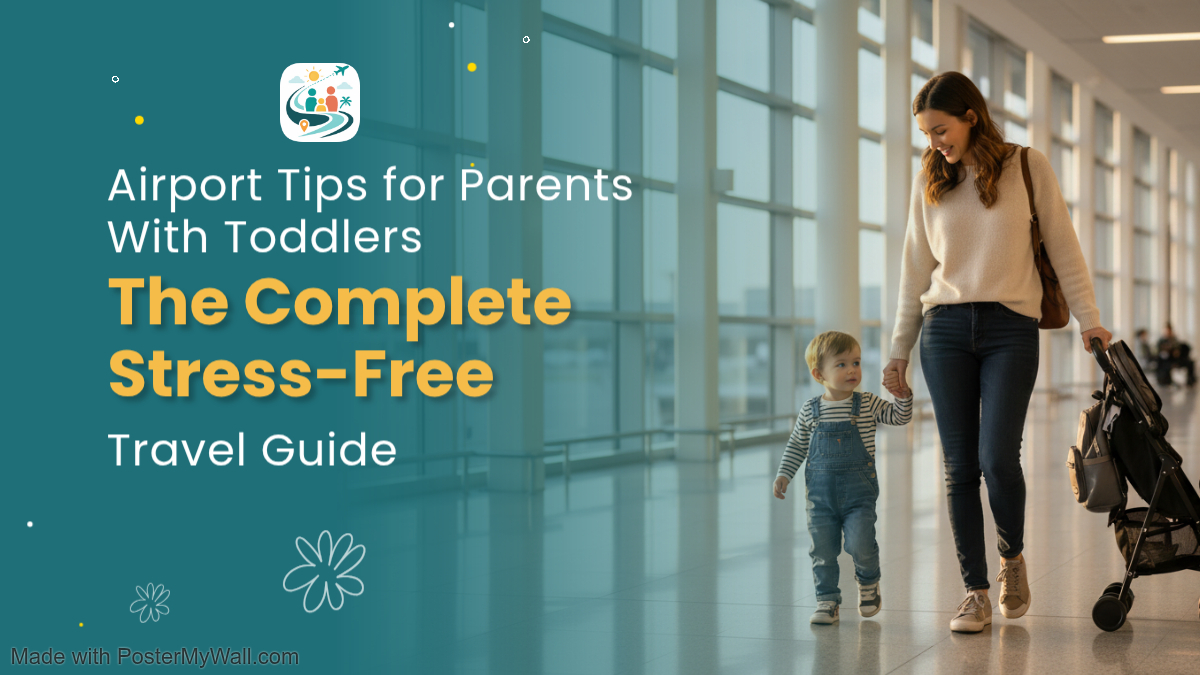
Traveling through an airport with a toddler means juggling luggage, security checks, and an active child at the same time. Most parents worry about the same 3 things: a public tantrum, missing a flight, or losing track of their kid in a crowded terminal. If this is your first trip, that worry is normal.
Airports test a toddler’s patience faster than the flight does. Toddlers get tired, hungry, or overstimulated quickly in a new environment, and a structured plan makes the difference between a rough day and a manageable one. This guide covers what to do from the night before to the moment you land.
Key airport survival tips for parents with toddlers
- Arrive early, but treat the time window as a range, not a fixed rule (more on this below)
- Keep snacks and activities within reach, not buried in a bag
- Use a stroller to cut down on walking fatigue
- Prep your TSA items before you reach the line
- Let your toddler move before boarding
- Locate restrooms and family facilities near your gate as soon as you arrive
- Pack a backup comfort item, understanding it may not fully replace the original
- Stay calm. Toddlers pick up on parent stress fast
Why airports are hard with toddlers
Bright lights, loud announcements, and crowded gates create sensory overload for a young child. Toddlers also have short attention spans and need frequent snacks, bathroom breaks, and movement. Preparation is what keeps a parent in control when all of that hits at once.
Airport timeline for parents with toddlers
Night before travel
Preparing the night before cuts stress the next morning.
Confirm travel documents. Keep boarding passes and ID in 1 place. For international travel, check passports and any required paperwork ahead of time, not the morning of.
Pack carry on essentials. Keep toddler basics within reach:
- Snacks and drinks
- Extra clothes
- Diapers and wipes
- Comfort toy or blanket
- Small medical kit
- Activity packs
Leaving home
Toddlers slow down every routine. Leave earlier than you think you need to. Build in time for bathroom stops, diaper changes, and the “I don’t want to” moment that shows up right when you need to walk out the door. A parent who isn’t rushing tends to have a calmer toddler too.
Arriving at the airport
Arrive early. A common baseline is 2 hours before domestic flights and 3 hours before international ones. Treat that as a starting point, not a fixed rule. It depends on airport size, whether you’re checking a bag, whether you have TSA PreCheck, and even the time of day. A small regional airport at 6 AM needs less buffer than a major hub at 4 PM.
Use strollers wisely
A stroller helps your toddler rest, helps you move faster, and carries bags. Many families keep the stroller until the gate, then gate check it there. Note that gate checked equipment can come back damaged or delayed, and airline liability for strollers works differently than it does for suitcases. Photograph the stroller before you hand it over.
Consider curbside check in
If your airport offers curbside check in, it can save time and energy, especially if you’re traveling alone with a toddler.
Check-in desk strategies parents often miss
Most parents don’t ask for help at the desk. You can. Ask about:
- Family seating help if your seats got split up
- Gate check tags for a stroller or car seat
- Early boarding tags, if the airline offers them
- Help with bulky toddler gear
Getting through airport security with a toddler
Security lines are stressful, but a few minutes of prep changes the experience.
Prepare before you reach the line
Before you enter the queue:
- Pull out toddler liquids and food
- Fold the stroller if needed
- Take your toddler out of the carrier
- Keep electronics ready for the bin
TSA toddler security cheat sheet
TSA options for families
- Standard security. Expect more steps and more waiting.
- TSA PreCheck. Kids under 12 can usually go through with a PreCheck enrolled parent, but this only works cleanly if the child is listed on the same reservation and the PreCheck indicator shows on their boarding pass. Enforcement isn’t consistent. If the indicator is missing at check in, ask the agent to fix it before you head to security, and build in extra time as a backup.
- Family lanes. Some airports have them, but they’re not always staffed. Check the airport’s website ahead of time, and have a plan B if the lane is closed when you arrive.
Find family facilities fast
Many airports have family restrooms, nursing rooms, and play areas, but families often waste time hunting for them.
- Check the airport map online before your trip
- Locate the nearest restroom as soon as you reach your gate
- If your toddler needs to move, look for a play area or a quiet hallway
Common airport mistakes and what to do instead
Let toddlers burn energy before boarding
Sitting too long raises the odds of a meltdown. Let your toddler walk and explore before you board. Use a play area if there is one. If not, take a lap around the terminal.
The gate routine
A simple, repeatable cycle works because it matches how toddlers regulate: movement, then a snack or drink, then a quiet activity. Repeat it if restlessness comes back. If your toddler still melts down, add a comfort item to the mix and give it a few minutes before trying the next thing.
Pack snacks and activities strategically
Snacks aren’t optional. They head off hunger driven meltdowns and give your toddler something to do.
Good snacks are:
- Easy to carry
- Low mess
- Familiar, not something new
Pack a few activities too:
- Coloring
- Stickers
- Small toys
- 1 “surprise” new toy, saved for when things get hard
Dress toddlers in comfortable layers
Airports and planes shift temperature often. Layers let you adjust fast, and comfortable clothes help with naps.
Deciding whether to bring a car seat
A car seat can help a toddler feel secure and sleep better on the plane, but it’s heavy to carry and adds another thing to manage through security.
Some context that helps with the decision: most US airlines let car seats fly free, so the cost isn’t the airline, it’s the physical hassle. Lightweight travel seats. For a lightweight option, a few specific models come up repeatedly in travel car seat discussions: the Maxi-Cosi Nomad and Urban Kanga, both marketed as portable and affordable, though exact weights vary by version. For older toddlers, the Ride Safer Travel Vest is a common alternative to a full seat for US travel. Among standard US-market seats, the Cosco Scenera Next comes up often as the budget pick, mainly because it’s lighter than most convertible seats even though it isn’t purpose-built for travel. are easier to carry than a full size convertible seat, which can run 25 lb or more. Rental car seats at your destination are often lower quality or poorly maintained, which matters if your toddler will sleep in it.
If you bring your own, a travel strap or rolling carrier makes it manageable through the terminal.
Boarding strategy: should families board early?
Some airlines offer family boarding. It sounds like a win, but it also means more time sitting still before takeoff, sometimes 20 to 40 minutes longer.
If your toddler struggles to sit still, boarding later can work better. If you need the extra time to get settled, gear stowed, and everyone buckled without rushing, boarding early helps. On a short flight, the extra sitting time works against you. On a long haul flight, getting settled early usually matters more than the extra wait.
Use layovers to your advantage
A layover gives your toddler a chance to move and reset. Run a short routine: restroom, snack, a short walk, then a quiet activity before the next boarding call.
What real parent reports say goes right and wrong in the air
Parents who’ve done this trip repeatedly mention a consistent pattern.
What tends to go right
A car seat on board gives a toddler a contained, familiar spot for takeoff, landing, and quiet time, even if they spend most of the flight sitting between 2 adults instead.
A compact, in-cabin stroller makes a tight layover manageable, especially when a connection means rushing between terminals with a toddler in tow.
Novelty beats routine. An airport-themed lift-the-flap book, playdough, and a tablet saved for after cabin lights go out tend to outperform the toys a toddler already has at home.
Offering a drink or snack during takeoff and landing helps with ear pressure, since swallowing relieves it.
What catches parents off guard
Messes happen mid-flight more often than expected. Pack extra clothes for the whole family within reach, not just for the toddler, and keep a couple of motion sickness bags handy.
Sealed bottles and pouches can leak or spray when opened at altitude. Unscrew the lid slightly first to release the pressure before opening it fully. One parent described a full cup of breast milk spraying over herself, her baby, and the row in front after skipping this step.
Two full size carry-on suitcases plus a stroller and a toddler is hard to manage in practice. Checking at least 1 bag tends to work better than carrying everything on.
A toddler who reliably naps at home may skip naps entirely on a travel day. Plan extra distractions for that scenario instead of counting on a nap to buy quiet time.
Emergency airport scenarios parents should prepare for
Airport problems happen. A backup plan makes them easier to handle.
Flight delays. Keep extra snacks and 1 extra activity ready.
Missed connections. Go to the gate agent or call the airline’s rebooking line at the same time, since lines move slowly and phone rebooking sometimes moves faster. Families don’t automatically get rebooking priority. You may need to ask for it directly. Keep toddler essentials in your main bag so you’re not digging through checked luggage. Ask about hotel and meal vouchers if the delay runs overnight. Short connections cause most missed-connection stories in family travel communities, especially under 1.5 hours on international routes. Delays at the departure airport are common enough that a tight layover often doesn’t survive contact with reality.

When a connection is missed, airline rebooking doesn’t always come with support. Some travelers report being rebooked on a flight up to 24 hours later with no hotel or meal voucher, especially when the airline classifies the delay as outside its control, like weather or air traffic control. Rebooking onto a partner airline can also stall if the 2 airlines don’t coordinate cleanly on their systems.
A few things help: build in 2 to 3 hours of layover time for international connections through a major hub, and check whether your travel insurance or credit card covers trip interruption before you fly, since some policies reimburse the hotel and meal costs an airline won’t cover.
One community account worth noting: a traveler who missed a connection at a US airport was located and reconnected with their party through a social media post, with other users and airport staff helping track them down. It’s not a formal system, but it shows social media can work as a real backup when official channels stall.
Bathroom emergencies. Find restrooms near your gate as soon as you arrive, before you need them.
Lost comfort item. If your child has 1 must-have item, bring a backup, but know it may not work as a direct substitute (see below).
Emergency airport backup checklist
- Extra snacks
- Backup comfort toy or small blanket
- Extra toddler clothing
- Wet wipes and hand sanitizer
- Portable charger
- Any toddler medication you may need, packed with its label visible for security
- Printed boarding passes or screenshots
- A small “surprise” distraction toy
Why the backup comfort item often fails
Standard advice says to pack a duplicate of your toddler’s favorite item. In practice, many toddlers reject an exact duplicate because it doesn’t smell or feel worn in the same way. A better approach is picking a close second favorite instead of a clone, or letting a backup item sit in your toddler’s bed for a few weeks before the trip so it picks up a familiar scent. If the original item still goes missing mid trip, expect a rough patch. A distraction, not a replacement, is usually what gets you through it.
Staying steady as a parent
Not every moment goes smoothly, and that’s normal. Track small wins instead, like a calm security line or an easy boarding. Toddlers pick up on parent mood quickly. Staying steady yourself tends to help your child settle faster too.
Leaving the plane with a toddler
Move slowly if you can, even though it feels rushed. Check the seat pocket and the floor for toys, snacks, and blankets before you go. If you gate checked a stroller, confirm where to pick it up before you head to baggage claim.
Choosing family friendly airlines
Airlines vary more than most parents expect. Before booking, check:
- Family boarding rules
- Seating policies for kids, including whether young children are guaranteed a seat next to a parent
- Baggage and stroller rules, including car seat weight limits
Airline family seating policies vary more than most parents expect, and they’ve shifted recently.
Southwest moved to assigned seating, which means families on basic fares can now get split up. The airline points parents toward paying for upgraded, extra legroom seats if they want a guaranteed spot next to their child.
United says it aims to seat children under 12 next to an adult, but that guarantee doesn’t extend to premium seats like Economy Plus, and the seats assigned this way are often the less desirable ones on the plane.
American commits to seating children under 15 next to at least 1 adult if you don’t pick seats yourself in Main Cabin or Basic Economy, with seats assigned automatically a few days after purchase.
Even paid seat assignments aren’t fully reliable. Some passengers have reported their paid seat selection reassigned at the last minute so the airline could seat a different family together. Airlines that seat families for free on basic fares also tend to assign the worst remaining seats, often the last row near the bathroom.
The US Department of Transportation encourages airlines to seat young children next to an adult at no extra charge, but that’s guidance, not a requirement, which is why policies differ so much airline to airline.
What to expect after you land
Toddlers often stay off for 24 to 72 hours after a flight, especially with a time zone change. Disrupted sleep and a shorter fuse are common in that window. It’s usually not a sign that something went wrong on the trip. Expect a few rough days, rebuild the normal routine gradually, and give it time before assuming anything beyond travel fatigue is going on.
Frequently asked questions
How early should I arrive at the airport with a toddler? A common baseline is 2 hours for domestic flights and 3 hours for international ones, but airport size, bag checks, and PreCheck status all shift that number.
Can I bring toddler snacks through airport security? Yes. Toddler drinks, formula, and baby food are usually allowed in reasonable amounts, though they may get extra screening.
Should toddlers use strollers in airports? Yes. A stroller cuts down on fatigue and keeps your child close in busy areas.
Are airport play areas helpful? Yes. They help toddlers burn energy, which tends to improve behavior later at the gate and on the plane.
Final thoughts
Airport travel with a toddler is never perfectly smooth, but preparation and experience make it far more manageable. Families who follow a clear routine, pack with intention, and stay flexible tend to have noticeably better trips. Toddlers mirror their parents’ mood, so a calm, prepared parent helps a child feel steady in a busy environment.


