




The first trip with a baby changes what parents worry about. Many stay awake the night before asking themselves: what if my baby cries the whole way? What if they get sick? What if I make a mistake that harms them? A short drive can feel stressful because your child depends on you for everything.
I have seen many families delay travel for months because online advice sounds confusing or contradictory. Some articles make travel sound dangerous. Others make it sound effortless. Healthy babies and toddlers can travel safely when parents protect a few specific things. This guide covers those things, along with the failures that standard checklists miss.
Quick travel safety takeaway
- Use a properly installed car seat every ride
- Move baby to a flat surface for sleep whenever possible
- Wash hands before feeding and use safe water
- Protect from heat, cold, and overcrowded environments
These four areas prevent most travel risks.
The 4 core travel safety rules
Four areas cover almost all the risk during travel with a baby or toddler:
- Proper restraint
- Safe sleep
- Clean feeding
- Temperature protection
Parents who focus on these rarely face serious problems during trips.
Car travel safety with babies and toddlers
Car rides worry parents the most, and that worry is justified. They carry the highest injury risk of any part of family travel.
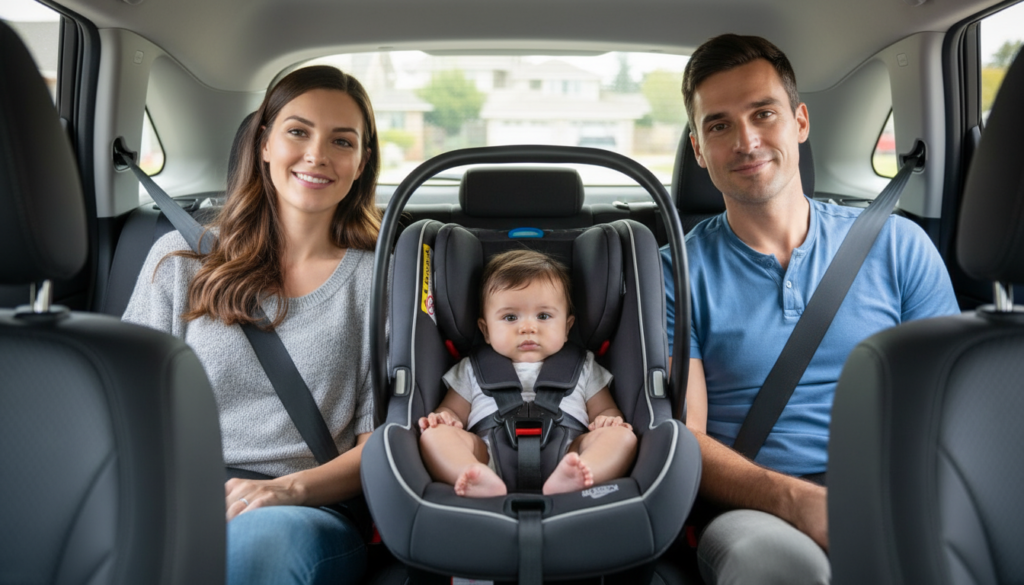
Car seat rules
- Keep rear-facing as long as possible
- Harness at armpit level
- No thick jackets under straps
- Seat should not move more than 1 inch at the belt path
How long can a baby stay in a car seat?
Young infants should not stay longer than 2 hours at a time. Their neck muscles are not strong enough to hold the airway fully open if the head slumps forward for long periods, which is why the time limit exists. After 2 hours, take a break, remove baby from the seat, and let them lie flat for a few minutes.
Move a sleeping baby to a flat surface after arrival. Do not let them finish a nap in the seat.
Why a seat that passes inspection can still loosen mid-drive
The 1-inch movement test at installation only tells you the seat was correct at that moment. Harness webbing relaxes as it warms from body heat, and a child who leans or slumps during sleep gradually pulls slack into the straps. A harness that passed the pinch test at departure can sit noticeably looser 2 hours later.
Check the harness again at every stop, not just at installation:
- Pinch the strap at the collarbone. If you can pinch excess fabric, tighten it.
- Look at the chest clip position. It should sit at armpit level, not lower.
- Feel for warmth or dampness in the padding, which speeds up webbing stretch.
Treat every rest stop as a harness recheck, not only a diaper or feeding break.
Flying with a baby safely
Air travel is generally considered safe for healthy infants, though most pediatricians suggest some caution before 6 to 8 weeks of age because of limited immune protection and cabin air exposure in an enclosed space. If your baby was born early or has any respiratory history, ask your pediatrician before booking rather than assuming the general guidance applies.
Ears during takeoff
Offer breastfeeding, a bottle, or a pacifier during ascent and descent to encourage swallowing, which helps equalize ear pressure.
This does not work the same way for every baby. If your baby has active congestion, a recent ear infection, or swollen eustachian tubes from teething, sucking will not relieve the pressure and can make the discomfort worse. A baby in real ear pain during descent typically shows sudden, sharp crying that starts abruptly rather than the gradual fussiness of normal tiredness or hunger. If your baby has had an ear infection in the past 1 to 2 weeks, ask the pediatrician whether it is safe to fly yet. Sucking alone will not fix pressure pain caused by a blocked tube.
Lap infant vs. own seat
A separate seat with an installed car seat is the safer option, but lap infants are commonly allowed on most airlines for children under 2.
The honest trade-off: a second ticket costs money, and gate-checking an FAA-approved seat adds hassle at security and the jet bridge. For a short domestic flight under 2 hours, some families reasonably choose a lap infant to manage cost. For long-haul or international flights, the extra hours of confinement and turbulence risk make the seat worth the price for most families. There is no universal right answer here. It depends on flight length, budget, and how your baby handles being held for hours.
Bassinet seats
Airlines with bulkhead bassinet seats usually restrict them by age and weight, often under 6 months and under a set kilogram limit that varies by aircraft. Requesting one at booking does not guarantee it. Allocation is often first-come at check-in, so checking in as early as your airline allows improves your odds.
Bulkhead rows also have no underseat storage. Everything you might need mid-flight has to come from the overhead bin, which changes how you should pack your carry-on. If you do not get the bassinet seat, plan your carry-on the same way you would for a regular row: essentials within reach, not in the bin.
Airport movement safety
Toddlers can run suddenly in busy areas. Use a stroller or hold hands through terminals, security lines, and gate areas.
Safe sleep while traveling
Baby should sleep:
- On their back
- On a flat, firm mattress
- Without pillows or blankets
Avoid long sleep in car seats, strollers, couches, or adult beds.
Hotel and Airbnb safety checklist
Children explore before they understand danger. Check the room before you unpack.
Hotel room child safety checklist
- Check balcony and window gaps
- Move blind cords out of reach
- Cover or block sharp edges
- Lock cleaning supplies and minibar
- Inspect crib mattress and gaps
- Block access to the bathroom
- Locate the nearest exit
The crib check most parents skip
A quick look at a hotel crib does not catch the real risk. Older or budget-property cribs sometimes have a gap between the mattress and the frame wide enough to trap an arm or leg. Test it directly: slide two fingers between the mattress edge and the frame on all four sides. If two fingers fit with room to spare, ask for a different crib or bring your own travel bassinet.
A simple request works: “Could I get a different crib? This one has a gap at the mattress edge I’m not comfortable with.” Front desk staff can usually swap it within minutes.
Feeding and health safety
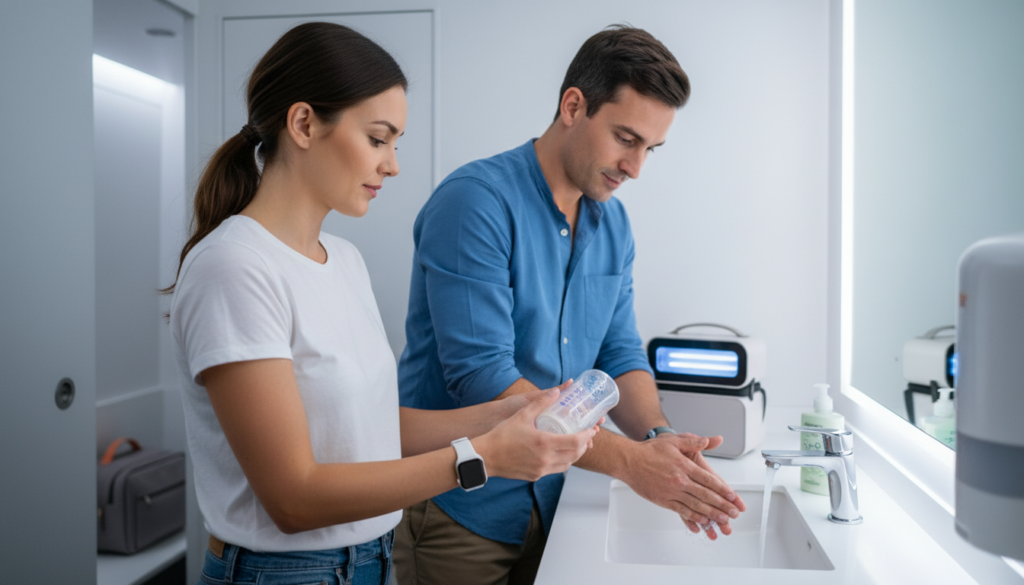
- Use safe water for formula
- Wash hands before feeding
- Avoid food left sitting out
Delay travel if baby has a fever under 3 months, breathing trouble, or dehydration. If you have to delay, call the airline or hotel as soon as you know. Most airlines waive change fees with a doctor’s note for infant illness, and many hotels will credit the night if you cancel before the day of arrival.
If you are traveling during RSV or flu season, factor that into your risk tolerance for crowded terminals and long layovers, especially for infants under 6 months.
Weather protection
Babies cannot regulate their body temperature as well as adults, but the two risks are not equal. Overheating is the more dangerous and harder to spot of the two. There is no shivering cue to alert you, and flushed skin is easy to miss under a carrier or blanket.
Check the back of the neck, not the hands, to judge temperature. Cold hands are normal. A hot, damp neck is not.
Heat: dress in light layers, offer fluids often, and avoid heavy swaddling in warm climates.
Cold: use layers you can add or remove, and always take off thick coats before buckling a car seat harness. A coat under the straps does two things wrong at once: it blocks a snug harness fit, and it traps heat once the car warms up.
Travel safety by age
Past age 2, physical containment alone (hand-holding, stroller straps) works less reliably, because toddlers at this stage test boundaries as part of normal development, not defiance. Practicing a stop cue at home before the trip, in a low-stakes setting like a park, gives you a tool that travels better than restraint does.
Real-life safety questions parents ask
One skipped nap rarely stays contained to one bad afternoon. An overtired toddler often looks wired rather than sleepy, which parents mistake for a second wind instead of exhaustion. Protecting the next 1 to 2 sleep windows works better than trying to force an early bedtime the same night.
Safety packing essentials
- Thermometer
- Fever medicine
- Hand sanitizer
- Child ID card
- Extra clothes
- Outlet covers
- First aid items
Keep this emergency info with you
- Child’s full name and birthdate
- Parent phone numbers
- Pediatrician contact
- Allergies list
- Medications
- Insurance details
The 72 hours after you get home
Most safety guides stop at arrival. Symptoms from travel exposure, whether from airport crowds, new water, or hotel surfaces, often show up 2 to 3 days after you get home, not during the trip itself. Parents frequently blame a random meal instead of connecting it to travel.
Watch for fever, changes in stool, or unusual fatigue in the 3 days after arrival. Recovery sleep debt can also mimic mild illness (low energy, crankiness, poor appetite), so give it a day before assuming your child is sick rather than just tired. If fever or dehydration signs show up, call the pediatrician rather than waiting it out.
Conclusion
The biggest change most parents notice happens after the first trip. Children adapt faster than parents expect, and most feared scenarios never happen. Safety comes down to a few consistent habits: proper restraint, safe sleep, hygiene, and close supervision, rechecked throughout the trip rather than only at the start. Family travel does not require years of waiting. With preparation and calm decisions, it can be safe and still create good memories for everyone.

